For any building, doors are an essential part in providing security, privacy, and environmental control for both the building and its occupants. That’s why it’s so important to have more information about doors to choose the best option for your buildings. One of the most important factors to consider when selecting a door for a building is the core of a door. The core is the internal structure that offers support, insulation, and durability.
There are different types of door cores, which we discuss in this blog post. We define each door core along with its pros and cons, so you can make the best decision. Additionally, we compare them and mention which one is suitable for different situations. Continue reading for more information.
What Are Door Cores?
A door core refers to the material inside a door that forms the structure of the door. The reason door cores are so important is that they affect the door’s weight, insulation properties, and overall performance. Different types of doors have various cores depending on their use cases.
Why the Core Matters
A door’s core is very important. It determines the door’s strength and durability, its ability to block sound, its ability to keep heat in or out, and even its level of security. The composition of the core directly impacts all of these factors. A solid wood core suits a front door because it is strong and stops noise well. However, an exterior door with a foam core would be a much better option if you’re looking for a door that does a great job of keeping heat in.
To put it simply, choosing the correct door core is essential if you want your door to perform a certain function, such as lowering your energy costs, maintaining noise control, or increasing the security of your house. If you don’t know how to choose the best door core, rest assured our expert customer service team will assist you.
What are Fire Door Cores?
Fire door cores are exactly what stop fires from spreading. These cores slow down the rate at which the door burns and provide fire resistance. Certified fire door cores are commonly rated at 30 or 60 minutes, and higher ratings exist for buildings at greater risk. The rating belongs to the complete doorset, tested as a whole, rather than to the core on its own.
Fire door cores are an essential component of a fire door’s protective system and are constructed from specifically engineered materials like particleboard. Consider the range from Egger. Here in the UK, they use a carefully selected mix of wood chips to create highly engineered 44mm and 54mm particleboard cores.
After testing and certification, Egger’s fire door cores comply with British Standard BS 476-22:1987 and fire door regulations. For fire doors, they also hold the BM Trada Q-Mark. They are also tested to Severe Duty grade, which covers workplaces, flats, schools and hospitals. Cores of this density help a doorset meet the sound insulation requirements set out in Approved Document E.
Hollow Core Doors
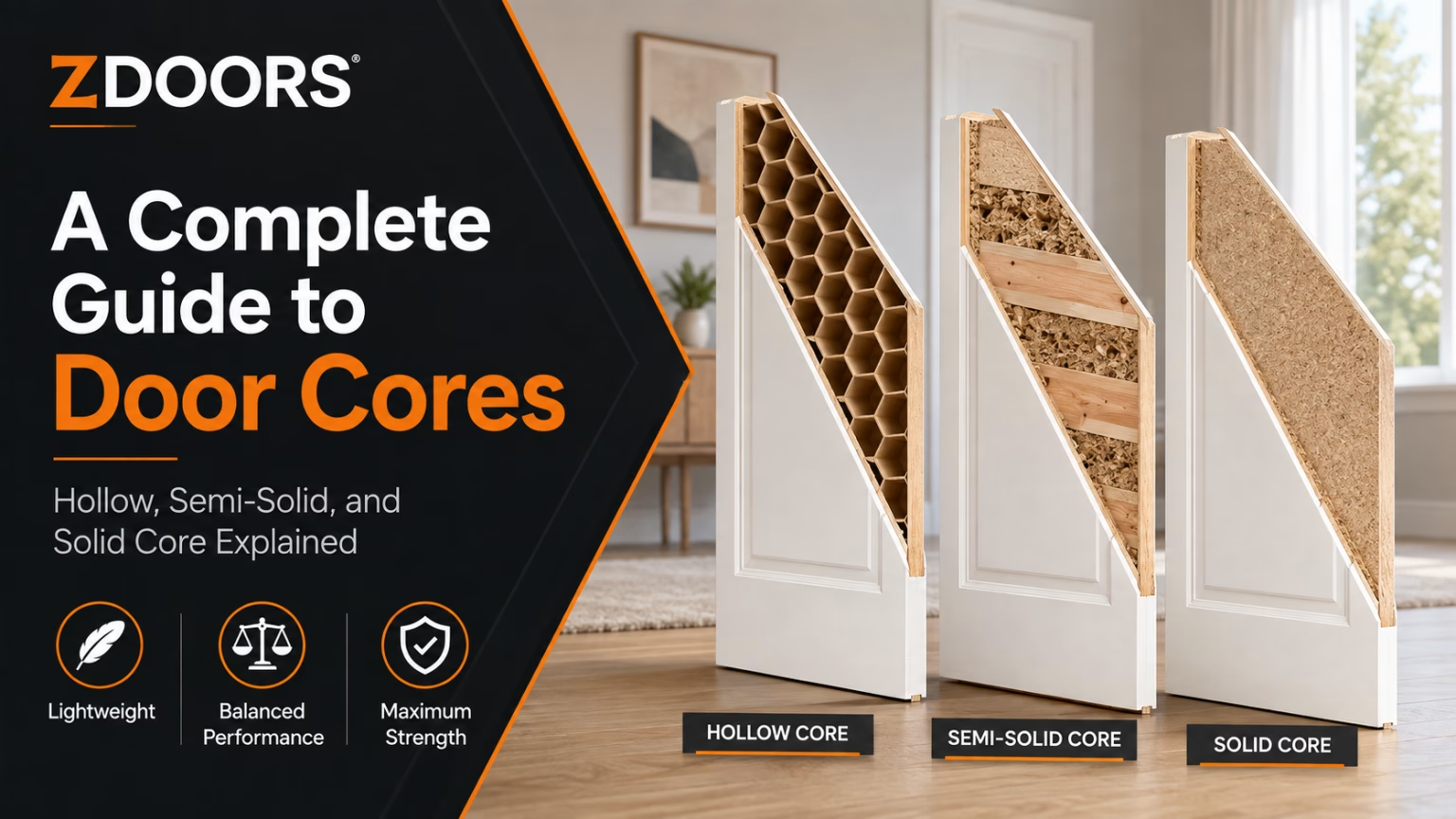
Often referred to lightweight or honeycomb doors, hollow core doors are constructed around an innovative cardboard framework that resembles a honeycomb. A thin layer of wood or another material is then applied on top. Hollow core doors are mostly used as internal doors for homes and are a popular option due to their lightweight construction, which aids installation. They provide less soundproofing and insulation.
Even though they are less expensive, they are not the best choice if you require strong security, higher protection for fire, and acoustic performance. However, they are ideal for areas where sound absorption and insulation are not major concerns, such as pantries and cabinets.
Hollow Core: Advantages
- Cost-effective option for budget-conscious buyers.
- They’re lightweight and easy to install, saving time and labour costs.
- They provide basic privacy and are suitable for storage and bathrooms.
Hollow Core: Disadvantages
- In comparison to other cores, they’re structurally weak and prone to damage.
- Ineffective for maintaining room temperature due to minimal thermal insulation.
- Poor soundproofing due to their construction.
- Lower quality because they’re made from cheaper materials.
Hollow Core: Best for
- Interior doors in low-cost projects
- Closet doors
- Pantry doors
- Bathroom Doors
Semi-Solid Core Doors
Expanded polystyrene, or EPS, is a high-density foam that is wrapped in a thin layer of MDF or plywood to create semi-solid core doors. As a result, price and performance are well-balanced. They are still lighter and less expensive than solid core doors, but they are stronger doors, better insulated, and more effective at blocking sound than hollow core doors. Semi-solid core doors are used in both residential and commercial buildings where a good balance between affordability and functionality is required.
While they are not as sturdy as solid core doors, they are more resilient and offer superior insulation compared to hollow core doors. Therefore, they are ideal for internal use when excellent security or fireproofing is not essential.
Semi-Solid Core: Advantages
- More durable and resilient to accidental damage.
- More lightweight than solid core.
- Better acoustic and thermal insulation than hollow core doors.
- Less expensive than solid core doors.
Semi-Solid Core: Disadvantages
- Not rated for fireproofing.
- Minimal soundproofing compared to solid core doors.
- Low insulation performance compared to solid core doors.
- Limited security due to the softer core material.
Semi-Solid Core: Best for
- Interior residential spaces (bedrooms, bathrooms, hallways).
- Commercial buildings where budget and performance balance are needed.
- Where you need moderate soundproofing.
- Where you need thermal insulation (e.g. offices, hotels).
- Where durability and insulation are needed.
Solid Core Doors
Solid core doors are the best choice when higher levels of fire-resistance are needed, and cost-effectiveness is not a major concern. They have a nice, substantial weight and feel since they are made of a combination of real wood and wood-based composites. On a product listing you will often see this called an engineered core. It usually means a dense particleboard or chipboard slab bonded between the two facings. In terms of security, sound absorption, and longevity, these doors are the best available.
They are ideal for crowded spaces, exterior doors, and any other location where additional privacy and soundproofing are required. Their features include their ability to block out noise, withstand bumps and bangs, and insulate against heat and cold.
Solid Core: Advantages
- Durable, and resistant to knocks and dents.
- Excellent soundproofing and thermal insulation.
- Need minimal maintenance, as they are less affected by weather changes.
- Better security compared to hollow and semi-solid core doors due to their strength.
Solid Core: Disadvantages
- Heavy, which makes installation more difficult and may require two people
- More expensive than hollow core or semi-solid doors
Solid Core: Best for
- Exterior doors or any location that needs high security.
- Areas that need high durability.
- High-traffic areas.
- Rooms that need more privacy and soundproofing.
Complete comparison of Hollow, Semi-Solid, and Solid Core doors
| Factor | Hollow Core Doors | Semi-Solid Core Doors | Solid Core Doors |
| Definition | Lightweight doors with a honeycomb cardboard framework. | Foam core wrapped in MDF/plywood for balance of cost & performance. | Made from wood composites for strength, security, and soundproofing. |
| Pros | Cost-effective, Lightweight, Easy to install | Durable, Better insulation, Easy to install | Durable, Excellent insulation & soundproofing, High security |
| Cons | Weak structure, Poor insulation & soundproofing | Not fire-rated, Limited security, Less soundproofing | Heavy, Expensive, Engineered rather than solid timber |
| Best For | Low-cost projects, Closet/pantry or bathroom doors | Residential & commercial spaces, Moderate soundproofing | High-traffic areas, Soundproofing & privacy |
| Cost | Budget-friendly option | Less expensive than solid core | More expensive than hollow and semi-solid doors |
| Weight | Lightweight | Heavier than hollow core but lighter than solid core | Heavier than hollow and semi-solid doors |
| Energy Efficiency & Insulation | Poor insulation and not energy efficient | It has a bit more structure than hollow core doors | Best for insulation & temperature control |
| Security & Durability | Lowest security & durability | More secure & durable than hollow core | Most secure & durable |
| Soundproofing & Noise Reduction | Poor soundproofing | Better than hollow core | Solid core doors, best soundproofing |
Cost
🔵 Winner: Hollow core doors
Hollow: If you’re looking for a cost-effective choice, hollow core doors are perfect for you. These doors are often less than half the price of solid core doors.
Semi-solid: If you want better performance, choose semi-solid core doors as they offer higher quality, are budget-friendly, and more durable.
Solid: The most expensive option but offers the highest quality and performance. They last for so long and provide extra security and soundproofing.
To put numbers on it: at ZDoors, hollow core internal doors start at around £40 and solid core doors start at around £95. Size, finish and glazing move both figures up, so compare like with like. Prices are correct at the time of writing.
Weight
🔵 Winner: Hollow core doors
Hollow: They are very lightweight and easy to install but not as strong or durable.
Semi-solid: They are slightly heavier than hollow core doors but lighter than solid core doors. They are more stable, durable, and not as hard to install.
Solid: They are heavier, making them more challenging to fit. They are stronger and more secure, and they cut noise well.
Energy Efficiency and Insulation
🔵 Winner: Solid core doors
Hollow: They can’t retain heat effectively. They allow heat to pass through due to their honeycomb structure, so they’re not a good option for insulation.
Semi-solid: Due to their denser construction, they perform better than hollow core doors.
Solid: They’re the best option for superior insulation and energy efficiency. They are ideal for exterior doors or spaces where temperature control is crucial due to their exceptional ability to prevent heat transfer and maintain a constant temperature.
Security and Durability
🔵 Winner: Solid core doors
Hollow: They have the lowest level of security and durability. Where security matters, they do not perform well.
Semi-solid: They’re more secure and durable than hollow core doors. They’re stronger and can withstand more force.
Solid: The most durable and secure option! They offer excellent protection against break-ins. They’re built to last, regardless of the weather conditions.
Soundproofing and Noise Reduction
🔵 Winner: Solid core doors
Hollow: They can’t block noise well. The honeycomb structure helps a little, but they’re not as effective as denser doors.
Semi-solid: They are a better option than hollow core doors for soundproofing.
Solid: The best soundproofing is achieved with solid core doors. Their density and thickness effectively filter sound, and they can significantly alter the amount of noise coming from outside or between rooms.
Different types of fire doors are available based on various factors such as their fire resistance (FD30-FD120, higher ratings for higher-risk areas), materials (steel, wood,…
How to Tell If Your Door Is Hollow or Solid
If you are working with doors that are already hung, you can usually work out the core without taking anything apart. Three quick checks:
- Knock it. Tap near the middle of the door, then near the edge. A hollow core sounds emptier in the middle, because there is nothing behind the facing but a cardboard lattice. A solid core sounds much the same wherever you tap.
- Lift it. Weight is the clearest sign. A hollow core door is light enough to carry comfortably in one hand. A solid core door of the same size usually takes two, and a fire door often takes two people.
- Check the fixings. On a hollow core door, hinge and latch screws only bite into a narrow timber block around the edge. If hinges have worked loose over the years, or a handle feels like it is pulling away, that points to a hollow core.
There is one more clue. If someone has hung a heavy mirror or a coat rack on the door and it has torn away from the surface, the door is almost certainly hollow. Hollow core doors hold weight only where there is timber behind the facing, and that is a narrow strip around the perimeter.
What is the right door core for your home or business?
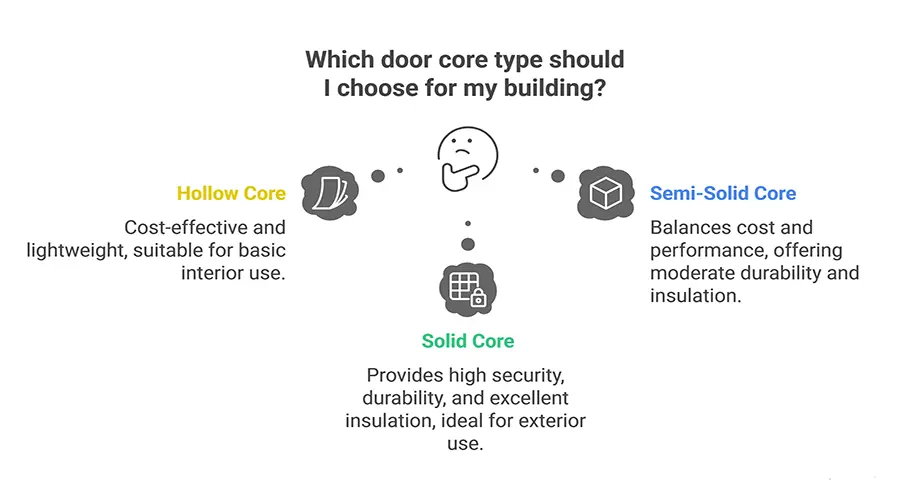
Choosing the best door core depends on your needs and budget. Let’s break down when to choose hollow, semi-solid, or solid door cores:
1. Choose hollow core doors when desiring basic interior use with a low cost. They’re suitable for basic, everyday options, including cupboards, pantries, and internal doors.
2. Choose semi-solid core doors when you need better security and durability, and a balance of cost and performance. They’re ideal for bedrooms, bathrooms.
3. Choose solid core doors when you need the highest levels of security, durability, performance, soundproofing, and moisture resistance.

Have you ever considered the safety of your home or workplace against fire hazards? Since fire risk always exists and can occur at times, purchasing…
Where can I buy high-quality doors?
Are you trying to find doors that stand out from the others? Then you ought to give ZDoors a look. You’re likely to find what you need among our wide range of doors for homes and businesses. We provide a variety of options, including economical hollow core doors, semi-solid core doors, and solid core doors, all offering the highest quality. If you want doors that will last, all you need to do is check out our collection.

LPD Ladder White Primed Moulded 4 Equal Panel V Cut Groove Ladder Design Smooth Internal Door lifestyle

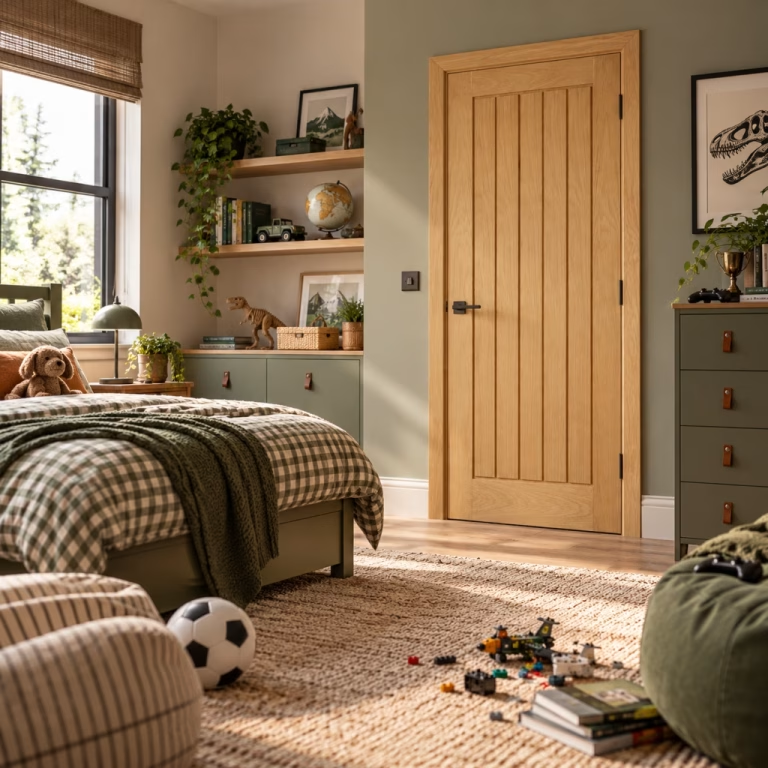
LPD Mexicano Oak 5 Vertical Panel Veneer Unfinished Internal Door

LPD Melbourne Oak Vertical Panel Veneer Pre-Finished Internal Door
Conclusion
In this blog post, we tried to discuss the different types of door cores (hollow, semi-solid, and solid) to help you choose the best option based on what you need and how much you want to spend. We also covered their features, pros, cons, and what they’re best for. To ensure the levels of security and durability you need, consider the tips mentioned in this blog post.
FAQ
1) What are the differences between hollow, semi-solid, and solid core doors?
Hollow core doors are cheap, lightweight, and suitable for simple interior applications. A step higher, semi-solids provide some soundproofing and improved durability. The premium choice is solid core, which is strong, weighty, and very good at insulating against heat and sound.
2) How Door Core Materials Impact Energy Efficiency and Insulation?
Your home will stay warmer in the winter thanks to denser materials, such as those used in solid core doors, which are far better at preventing heat transmission.
3) Are Solid Core Doors Worth the Extra Cost?
Yes! Solid core doors are a good investment if you value durability, security, and soundproofing. Although they may be more expensive up front, they will endure longer and perform better all around.
4) What is a solid core door?
A solid core door is one where the space inside the door is filled rather than left hollow. The filling is usually an engineered core of dense particleboard, not a single piece of timber. That catches people out: solid core and solid timber are not the same thing, and a solid timber door is a separate and dearer product. If weight and sound matter to you, the core is what you are paying for.