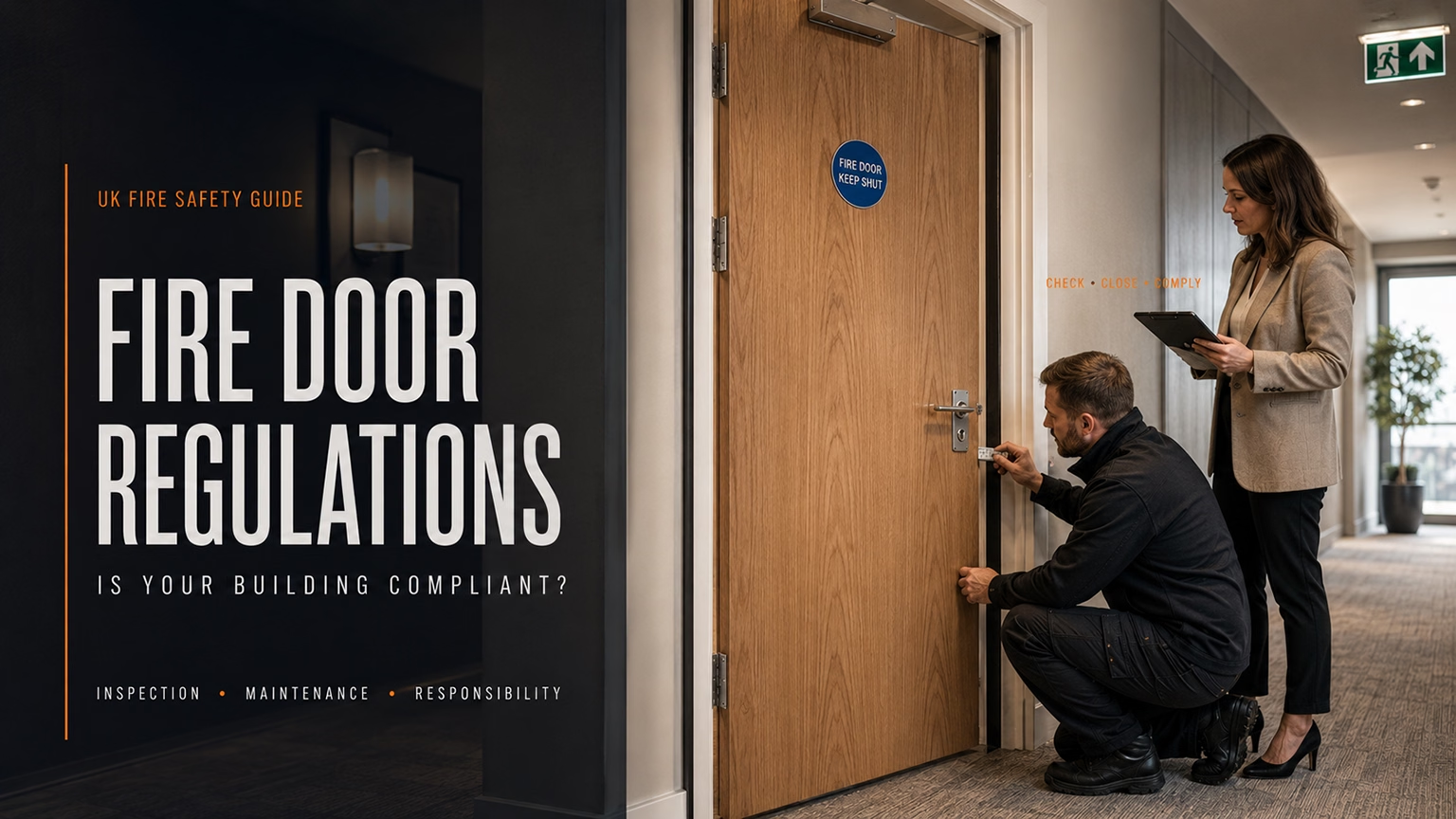
To ensure the safety and compliance of your building, it’s essential to understand the UK Fire Door Regulations. In 2026, fire door regulations will focus on fire prevention and occupant safety more than ever. The revised rules emphasise how important fire doors are in saving lives and minimising property damage during fires.
If you’re a property owner or project manager, you should be aware of changes to fire safety regulations as they impact both commercial and residential buildings. In this blog post, we’ll explain what these regulations mean for your property and how you can ensure compliance.
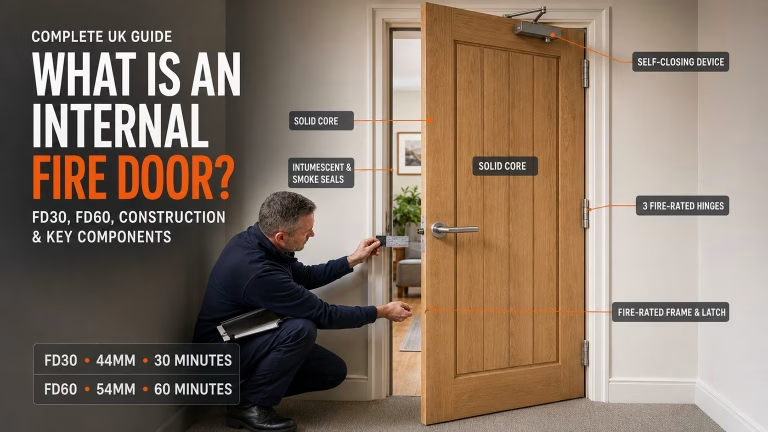
Internal fire doors are critical components of building protection systems designed to prevent the spread of fire and smoke within a structure.
Who is responsible for fire doors?
Based on fire door regulations, the building owner, landlord, project managers or anyone responsible for the safety of a property is typically responsible for fire doors, depending on the property’s structure. Lease agreements often outline responsibilities for leaseholders; some may be in charge of maintaining the fire doors in their apartments, while others may be under the building owner’s management. For buildings to conform with fire safety rules, it is essential that property managers and owners ensure entrance and internal fire doors are regularly inspected, maintained, and fulfil safety standards.
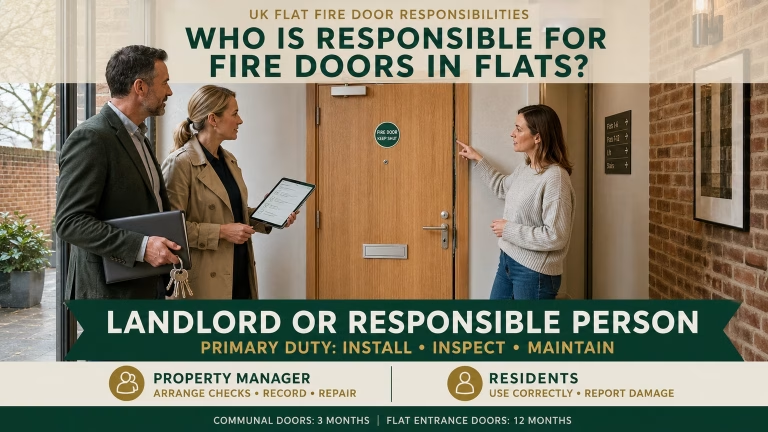
Landlords need to install, inspect, and maintain compliant fire doors under the Regulatory Reform (Fire Safety) Order 2005 and Building Regulations. Tenants need to use…
What are the fire door regulations?
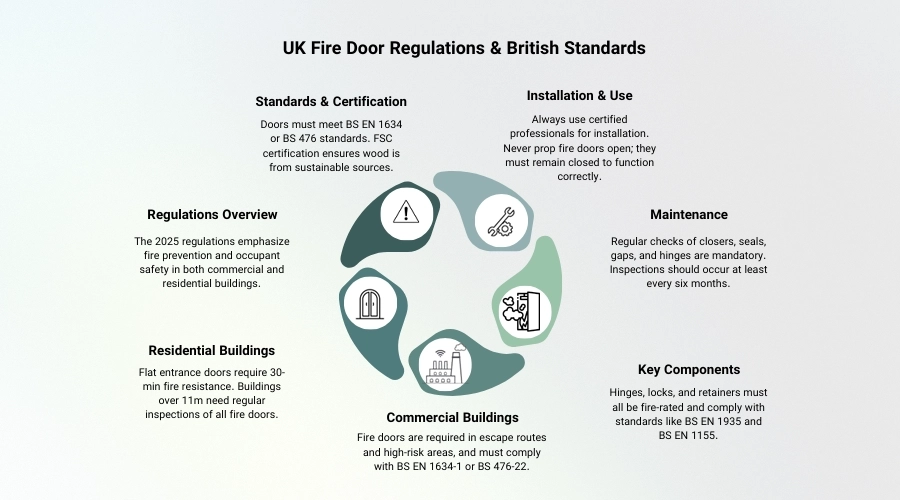
To ensure fire safety in buildings, minimise building damage, and prevent the spread of fire, we should be familiar with fire door regulations and take the essential steps towards this. Here are the regulations you should understand:
Fire door regulations for flats (Residential buildings)
Do I need fire doors in my house? Based on UK regulations, flat entrance doors need to be at least 30-minute fire resistance to give enough time to escape. The responsible people of residential buildings more than 11 metres must:
- Inspect all fire doors in communal areas every 3 months.
- Inspect all flat entrance doors once a year.
- Inform residents about the importance of fire doors.
For buildings under 11 metres is necessary to use fire doors for entrance too.
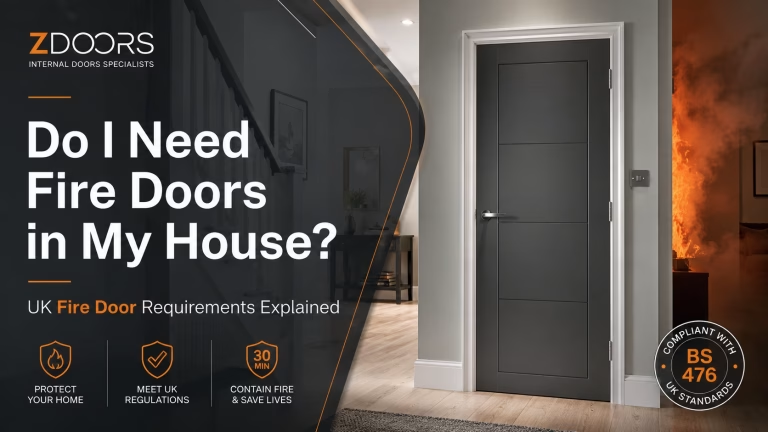
Fire doors prevent fire and smoke to a specific area, preventing them from spreading throughout the premises. This containment is vital, as it preserves escape…
Fire door regulations for commercial buildings
Fire doors, designed to control flames and provide safe escape routes, are essential safety components in commercial buildings. To ensure occupant safety, strict regulations govern their construction and maintenance in the UK. All public or commercial buildings must have fire doors.
Fire doors in newly constructed buildings or those undergoing a change of use must comply with BS EN1634-1:2014 or BS 476-22:1987. The local authority building inspector may request proof of compliance.
For any significant alterations or changes in use, a building already governed by the Regulatory Reform (Fire Safety Order) 2005 must comply with Regulation 38. This requires providing the building’s Responsible Person with information on fire safety, including details about fire doors and their installation.
Key Regulations and Standards:
To safeguard stairwells and hallways, prevent the spread of smoke and fire, and reduce the risk of fire, these regulations must be followed for commercial buildings:
Placement:
- Escape routes: To ensure safe evacuation.
- Compartments: To divide large areas.
- High-risk areas: Rooms with fire hazards, such as kitchens or storage areas for flammable materials.
Fire Door Specifications:
- Depending on the time required for evacuation, the fire resistance rating is typically either FD30 (30 minutes) or FD60 (60 minutes).
- Both sides must have clear signage, such as “Keep Closed,” and doors should contrast with the surrounding walls for easier identification.
Maintenance and Compliance:
Regular checks for damage, closure mechanisms, seals, and signage are crucial to ensure fire doors remain operational. Legal fines may be imposed for non-compliance.
Fire door hinges regulations
It’s essential to ensure that the hinges you choose for fire doors comply with the relevant UK standards and regulations. Fire door hinges in the UK must comply with BS EN 1935. The hinge should bear both a UKCA mark for the UK market and a CE mark, indicating compliance with EU regulations. Depending on the fire door’s classification, these markings confirm the hinge’s fire resistance testing and its ability to maintain integrity for a specified duration, usually between 30 and 240 minutes (FD30 to FD240). Products placed on the UK market after Brexit must display the UKCA mark. In 2025, fire door hinges must still comply with BS EN 1935.
Fire door Retainer regulations
Any mechanism that keeps a fire door open must automatically release when a fire alarm goes off, allowing the door to close, according to the Regulatory Reform (Fire Safety) Order 2005 (RRO). It is illegal to prop open fire doors with wedges or other objects, as this can prevent them from working correctly in a fire.
- BS EN 1155 – Electrically Powered Hold-Open Devices for Swing Doors: This standard ensures that fire doors held open by electrically powered mechanisms will automatically release in the event of a power outage or when the fire alarm rings. Compliance with this standard is essential for safety.
- BS 7273-4 – Code of Practice for the Operation of Fire Protection Measures: This guide emphasises that fire door retainers must be connected to the building’s fire alarm system to function properly in a fire. It also outlines the installation and maintenance requirements for these devices.
Fire door locks regulations
Because there must be an unobstructed escape route, fire doors should never be locked while a building is occupied. Fire door locks may be used when the building is unoccupied. Similar to hinges, every component used in a fire door must be fire-resistant to meet UK standards. Additionally, all hinges used in a fire door must be fire-rated.
Fire door maintenance regulations
The Regulatory Reform (Fire Safety) condition of 2005 mandates that fire doors must be kept in good operating condition and get the necessary maintenance. Even with minor damage, a fire door can become useless and be unable to stop fire spread and smoke. Maintaining fire-resistant doors is not an advice, but a rule that must be followed due to new regulations.
Regular maintenance checks include:
1. Making sure door closers and latches work properly.
2. Checking seals and fire-resistant strips for wear or damage.
3. Ensuring gaps between the door and frame are within the required limit (usually 3mm).
4. Inspecting hinges, glass, and signs for any issues.
5. They need to be inspected for wear or damage at least every six months. (Checking high-traffic doors may be necessary more frequently.)
6. Inspections should be performed on every component, including the door, frame, hinges, seals, and closing mechanisms.
7. Test them to make sure they fully close and latch on their own when released from the open position, free of obstructions.
8. Keep thorough records of all maintenance, repairs, and inspections, documenting any findings and the steps followed.
British standard for fire doors
Complete fire doorsets must adhere to specific standards, although they may also be used in conjunction with other UK and European requirements, such as those pertaining to weather resistance and security. The British fire door standards are as follows:
Fire Door Testing Standards
- BS EN 1634: This is the primary European standard for testing complete fire door assemblies, ensuring fire resistance and compliance across all component parts.
- BS 476: A long-established UK standard, still in use (as of 2023), that also tests the fire resistance of doors.
Industry Roles and Responsibilities
• Architects and Specifiers: They need to confirm that fire doors adhere to BS EN 1634 or BS 476.
• Building contractors: They are in charge of making sure fire doors are installed correctly.
• Owners and operators: To guarantee continuous compliance, fire doors must be maintained in accordance with requirements.
FSC Certification
FSC certification (Forest Stewardship Council) is a very important factor, especially for those who care about sustainability in their lives. This certification guarantees that wood products come from forests that are managed ethically. A fire door made with FSC-certified timber ensures that the wood used comes from sustainably managed forests, promoting ethical and environmentally friendly practices.
Using FSC-certified products can improve a building’s environmental credentials and earn credits under many green building rating systems. So, if you want to support sustainability, FSC-certified fire doors are an excellent choice.
The Forest Stewardship Council (FSC) is a non-profit that protects forests. They certify forests that meet high environmental and social standards, and products from these…
Can I have a window in a fire door?
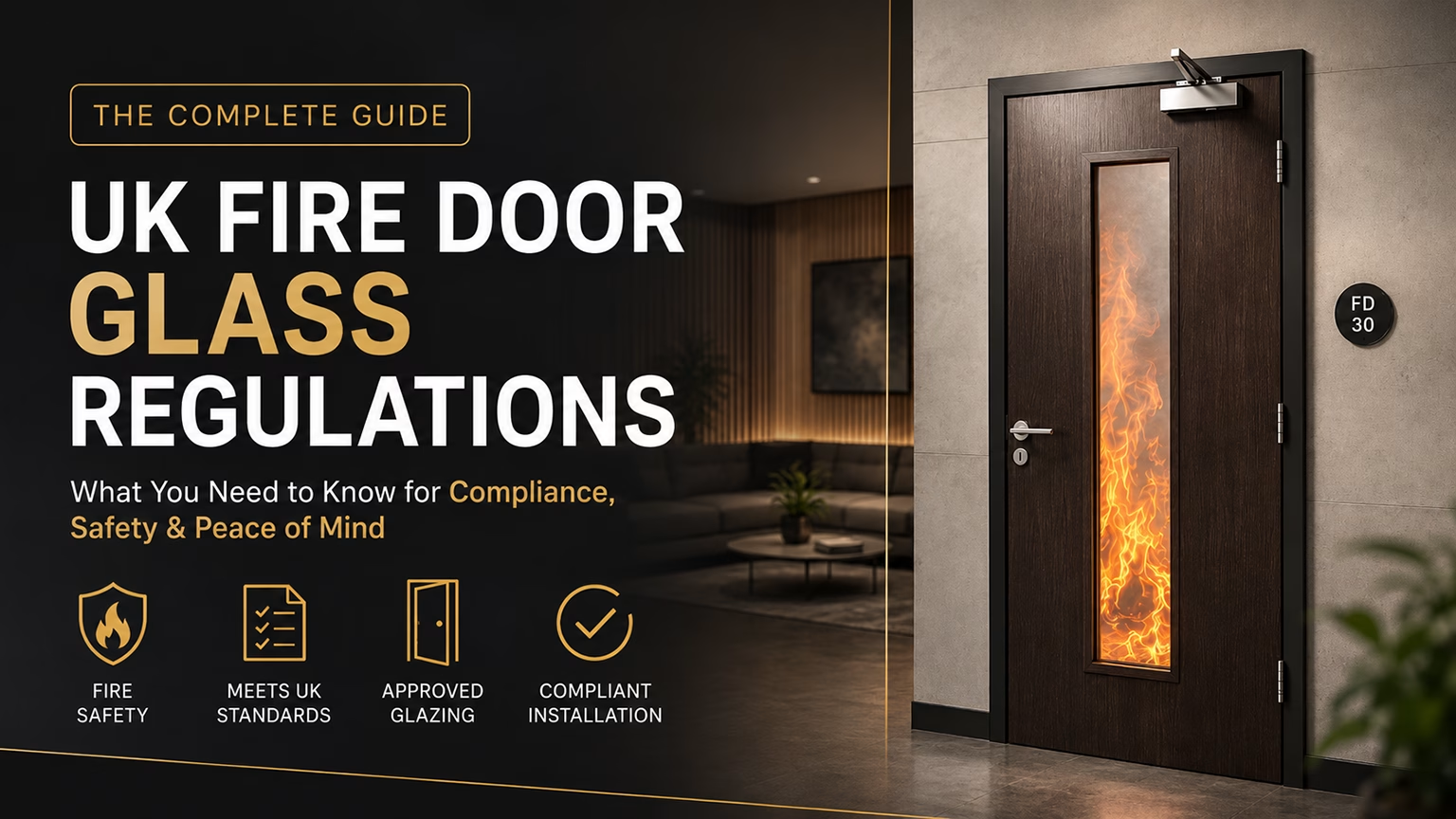
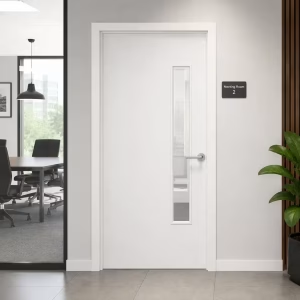
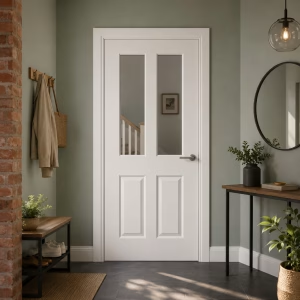
Sure! Many people prefer fire-resistant doors with windows to allow light to pass through. These are known as fire doors, which include a window called a vision panel. These panels are made of fire-resistant glass, such as wired glass or laminated glass. Remember, you cannot add glazing to your fire-resistant doors by cutting them yourself—this must be done by a qualified specialist.

Have you ever considered the safety of your home or workplace against fire hazards? Since fire risk always exists and can occur at times, purchasing…
Firefighter’s tips for fire door installation and use
There are some fundamental rules that need to be adhered to while using and installing fire doors safely:
| Dos: | Don’ts: |
| When installing fire doors, always work with certified professionals. | Never prop fire doors open – they must remain shut to save lives. |
| Verify the door’s certification to make sure it conforms with either BS EN 1634 Part 1 or BS 476 Part 22. | Avoid attempting to install fire doors yourself; every component is crucial for safety. |
| Verify that the door has both fire and smoke seals. | Do not allow tenants to replace fire doors in multi-occupancy buildings like flats. |
| Verify that the door handles shut correctly. | Never remove the self-closing device fitted to a fire door. |
| Confirm that every part is fire-resistant, including letterboxes and seals. | Don’t ignore damaged doors – repair or replace them immediately. |
| To avoid harm from slamming or damage to frames or hinges, use the appropriate door closers. |
Conclusion
To protect lives and your property, you must ensure that compliance with UK fire door regulations in 2025 is met. This is not just an advice or a legal responsibility; it is a life-saving measure. Fire door regulations are written to reduce the risk of fire damage, as they have been proven to minimise property loss and save lives during fires. Recognising their importance, the UK holds an annual campaign called Fire Door Safety Week.
This initiative raises awareness about fire doors and their role in improving safety, emphasising that every properly installed fire door contributes to saving lives. At ZDoors, we take fire safety seriously. That’s why all our fire doors are designed and manufactured to meet the latest UK Fire Door Regulations for 2025.
FAQ
1) What are the new fire door regulations for 2025?
The amended UK Fire Door Regulations for 2025 focuses on strengthening fire prevention and occupant safety. Key improvements include stronger inspection and maintenance requirements, enhanced standards for fire door components, and more emphasis on compliance in both residential and commercial buildings.
2) What are fire door regulations for residential buildings?
Residential building fire door regulations require:
• Flat entrance doors to provide at least 30 minutes of fire resistance.
• Fire doors in communal areas of buildings over 11 metres to be inspected every 3 months.
• Flat entrance doors to be inspected annually.
• Fire doors to be installed for entrance doors in all buildings, including those under 11 metres.
3) How often does a fire door need to be inspected?
Fire doors in communal areas must be inspected every 3 months, and flat entrance doors must be inspected annually. For high-traffic areas or critical locations, more frequent checks may be necessary.