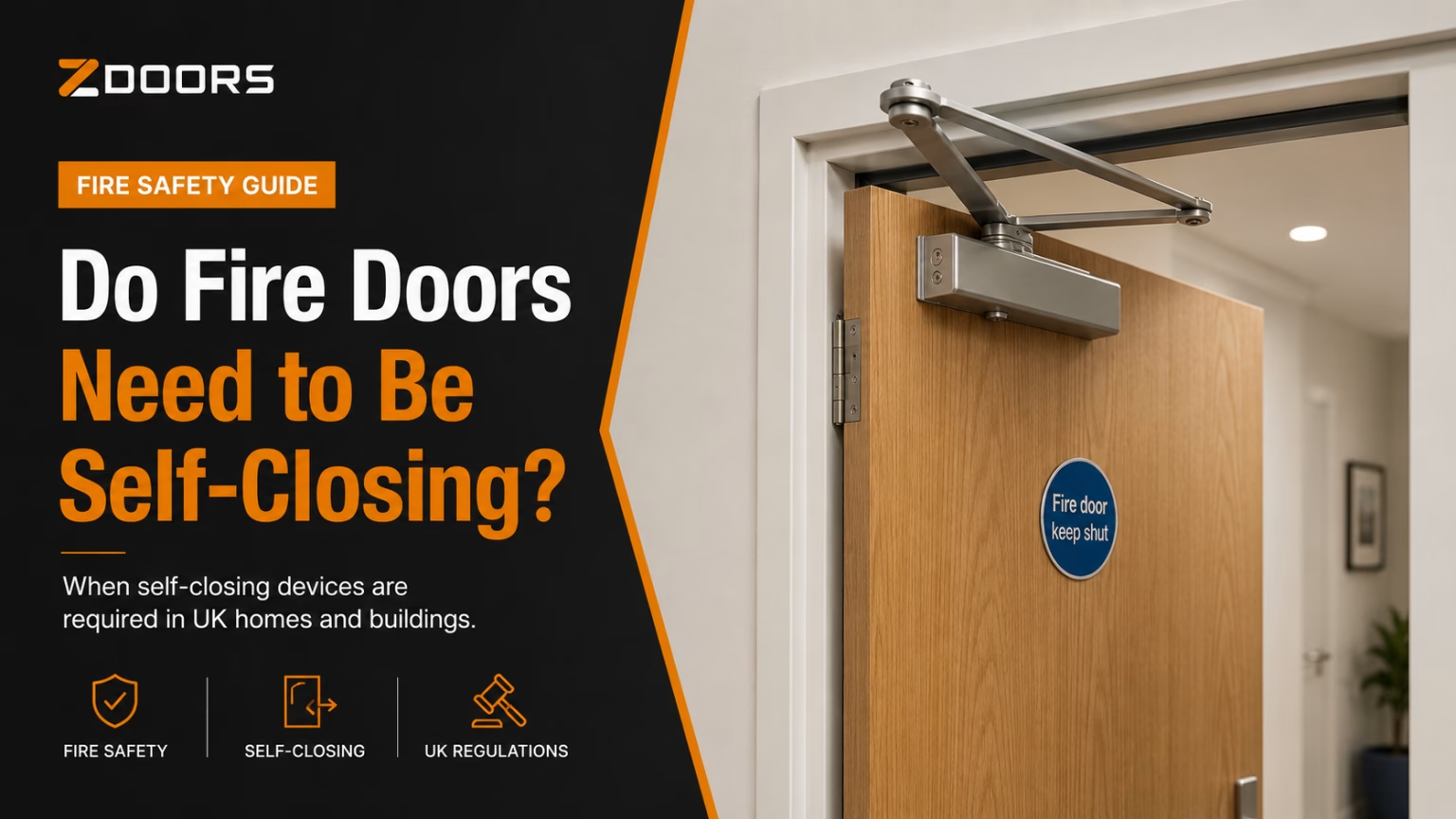
In previous articles, we mentioned how important fire doors are in the event of a fire. They prevent fire and smoke from spreading and can save people and properties. But can they still be effective if they cannot close properly?
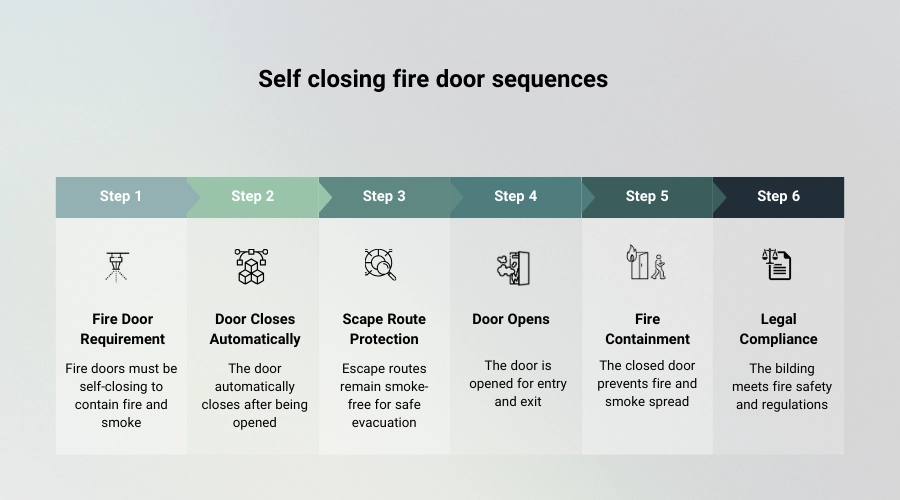
Fire doors must have a tight seal and be self-closing. This ensures that the fire is contained and that escape and rescue routes remain smoke-free for as long as possible. We will look at the workings of self-closing fire doors in this Z Doors blog post.
What is a self-closing fire door?
A self-closing fire door is designed to automatically close after it has been opened, as the name suggests. Do you know what makes these doors essential? In an emergency situation, most people only have experience with evacuation drills. This, together with the anxiety and even fear that comes with a real emergency, can cause occupants to hurry out of the building and forget to close the doors. Therefore, a self-closing mechanism is essential; it ensures that the door will close, maintaining its protective qualities.
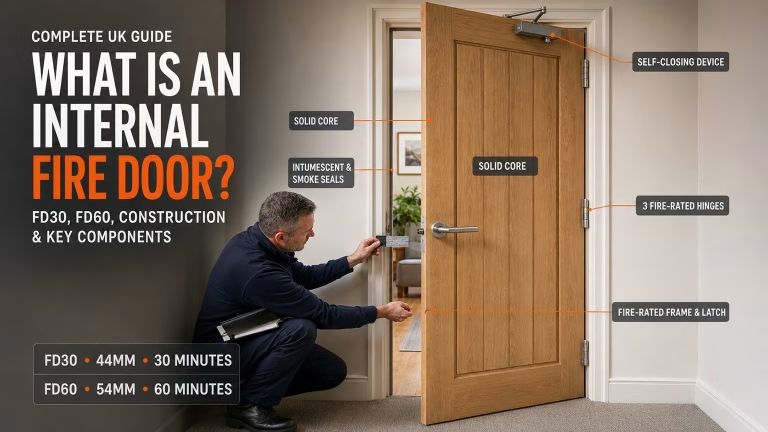
Internal fire doors are critical components of building protection systems designed to prevent the spread of fire and smoke within a structure.
Do fire doors need to be self closing?
Yes, self-closing fire doors are required by construction requirements. For fire doors to operate correctly and constantly safeguard a building from fire, door closers are necessary. However, self-closing fire doors may be unlawfully propped open since they are perceived as barriers to regular use. Specialised fire door closers that enable doors to stay open during regular operation but automatically close in the event of a fire are available to address this issue.
Regulations of self closing fire door in Uk
For the safety of building occupants, it is a legal requirement for many businesses to install self-closing fire doors. But where are self-closing fire doors required?
- Escape routes separating two or more storey exits.
- Corridors that need subdivision every 12m in length.
- Dead-end corridors exceeding 4.5m in length.
- Staircase enclosures to separate circulation spaces.
- Doors opening onto external escape stairs.
These doors must have fire door closers that comply with BS EN 1155 or BS 5839: Part 3 based on fire door regulations.
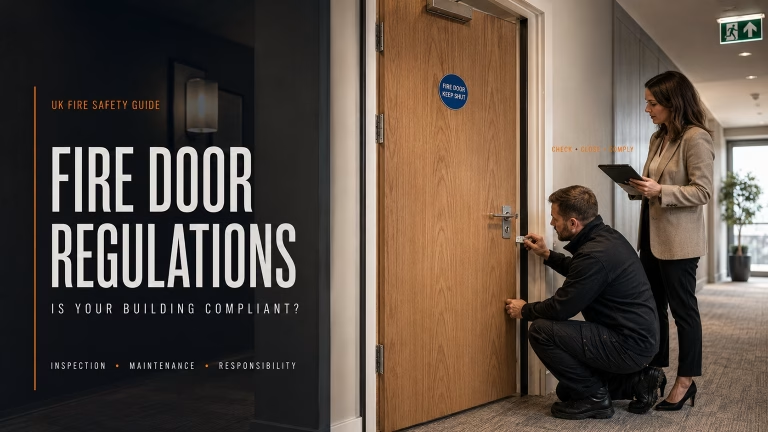
To protect all buildings from fire and enhance fire prevention, the UK fire door regulations were updated in 2025. Flat entrance doors must have at…
Self-Closing Fire Doors in Different Buildings
Residential Buildings (e.g., care homes, hotels, student accommodation):
- All fire doors must have self-closing devices.
- Exceptions: Cleaner cupboards, plant rooms, and other high-risk spaces, which should remain closed and locked when not in use.
- Blocks of flats: The front door of each flat must have a self-closing device to separate it from communal areas.
Private Homes:
- Self-closing devices are only required for doors leading to an integral garage.
- Other internal fire doors are not legally required to be self-closing but are recommended for additional safety.
Different types of self-closing devices and their relevant standards
In the following table, you can see the different types of self-closing fire doors, their mechanisms, use cases, and relevant standards:
| Type | Mechanism | Use Case | Relevant Standards | Key Considerations |
| Hydraulic Door Closers | Controlled and adjustable closing speeds, hydraulic fluid for smooth operation. | Suitable for care homes, hospitals, and buildings where slower closing speeds are needed for safety (e.g., for less mobile occupants). | BS EN 1155, CE Marking, BS 5499-10 | Adjustable closing speed for safety, especially in high-risk environments. |
| Spring-Loaded Door Closers | Spring mechanism that allows door to close after being opened. | Ideal for lighter doors in residential or low-traffic areas. | BS EN 1155, CE Marking, BS 5499-10 | Less maintenance required, but may not be suitable for heavier or high-traffic doors. |
| Hold-Open Devices with Auto-Close | Electromagnetic mechanism that holds the door open but closes it automatically in the event of a fire. | Useful in areas where doors need to stay open (e.g., corridors) but must close during a fire emergency. | BS EN 1155, BS 5839: Part 3, CE Marking, BS 5499-10 | Allows doors to remain open during normal use; automatic closing in emergencies. |
| Floor-Spring Door Closers | Mechanism placed at the floor to control door closing. | Common in commercial buildings with heavier doors, or where aesthetic preference requires minimal hardware visibility. | BS EN 1155, BS 5499-10, CE Marking | Ideal for heavy doors, minimal visibility of hardware, durable for high-traffic use. |
How do self-closing fire doors work?
A large number of self-closing fire doors feature a metal arm with gears inside that ensures the door always closes on its own. Hydraulic components inside regulate the door’s speed to ensure a smooth closure. Propping fire doors open is dangerous and often happens when people enter and exit. To address this, you can use a special door closer that uses magnets to keep the door open during normal use while automatically closing when the fire alarm sounds. This keeps everyone safe and makes the door easy to use.
Features of door closers
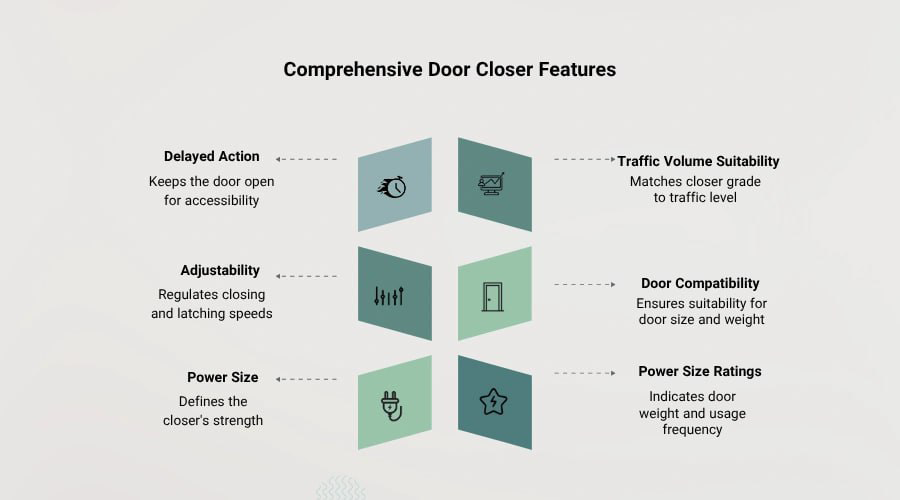
The features of door closers include:
- Power Size: Defines the closer’s strength; an excessively high value may result in slamming or difficulty opening the door.
- Adjustability: The closing speed, which regulates how quickly the door closes, is one of the adjustments available for some models. Additionally, the latching speed modifies the latching speed.
- The delayed action function: It is helpful for accessibility, as it keeps the door open for a certain amount of time before closing.
- Door Size & Weight Compatibility: The closer needs to be suitable for the door’s size, weight, and use.
- Traffic Volume Suitability: Grade 1 closers are perfect for high-traffic locations like schools and hospitals, while light-duty closers are appropriate for doors that receive little to moderate use.
- Power Size Ratings: The weight of the door and how often it is used determine the power size rating, which goes from 1 (lowest) to 6 (highest).
Advantages of self-closing fire doors
Self-closing fire doors offer a full array of benefits to any property:
- Fire Containment: They help to stop fires from spreading to other parts of the building.
- Increased Escape Time: They give people more time to get out safely in a fire.
- Legal Compliance: They ensure your building meets all the necessary legal requirements.
- Peace of Mind: They give building occupants a sense of security.
- Durability: They are strong and long-lasting and provide reliable protection.
General advice to Self-Closing fire doors
When you decide to buy self-closing fire doors, there are some considerations, including:
☑️ Automatic Door Releases: Doors with automatic releases in buildings that provide a sleeping risk should be closed at a certain hour every night and kept closed while people are asleep. In order to keep separation and lower the risk of fire damage, you should close all fire doors at the end of the working day.
☑️ Weekly Testing: To guarantee correct operation, all doors with automatic releases should undergo weekly fire alarm testing. You can also avoid warping of the fire door leaf by regularly releasing the doors.
☑️ Routine Maintenance: To guarantee dependable operation, self-closing devices should be examined, tested, and serviced according to usage at regular intervals.
☑️ Remember, when deciding to buy self-closing fire doors, pay attention to reliable automatic releases and consistent weekly testing. Here at Z Doors, we care about these factors and offer dependable, long-lasting fire protection. Just check our fire door page for more information.
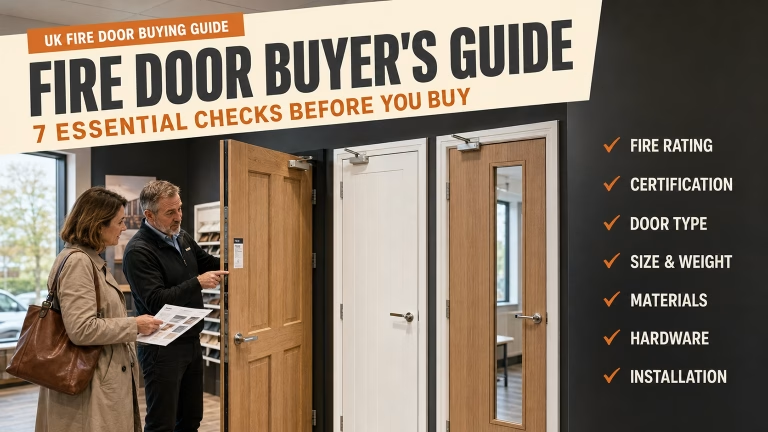
Have you ever considered the safety of your home or workplace against fire hazards? Since fire risk always exists and can occur at times, purchasing…
Conclusion
Now you know the answer to this question: “Do fire doors need to be self closing?” It is essential that you understand the significance of self-closing fire doors. They ensure that in the event of a fire, smoke and flames are prevented from spreading. As a result, everyone within the structure will be protected. However, they need adequate care and maintenance because they only function correctly when they are inspected and looked after regularly.
The use of professional fire safety services, such as those provided by Midsummer Fire Protection, is required by the Regulatory Reform (Fire Safety) Order, or RRO. It emphasises that only qualified individuals or organisations should conduct fire risk assessments and that these evaluations, which should include routine inspections of self-closing fire doors, must be carried out.
FAQ
1) Do fire doors need to be self closing?
Yes, fire doors must be self-closing to ensure they close automatically in the event of a fire, containing smoke and flames.
2) Is it illegal to prop open a fire door?
Yes, propping open a fire door is illegal as it compromises its safety function. Fire doors should always remain closed unless held open by an approved device.
3) Where do you need self-closing doors?
Self-closing fire doors are required on escape routes, in corridors, near staircases, and in areas where fire compartmentalisation is necessary to protect occupants and properties.