

Should fire doors be wedged open? The short answer is no! You should never leave a fire door stuck open indefinitely. It is essential to keep fire doors closed since they are made to restrict smoke and fire in order to save lives. However, if done properly and the fire door isn’t kept open for longer than is necessary, there are some specific situations in which propping it open momentarily might be appropriate. Read on to learn when it’s acceptable to wedge open your fire door and how to do it properly.
What Is the Purpose of Fire Doors?
So, what is a fire door? Most residential and commercial structures must have fire doors for both practical and legal reasons. Their purpose is crucial, even though they are occasionally viewed as an annoyance because they are heavy and slow down individuals who are in a hurry. By preventing smoke and fire from spreading, fire doors lower the possibility of significant property damage and enable safe evacuation. They can only accomplish this, though, if they remain closed. For this reason, a notice that reads, “Fire door, keep shut,” is always placed on them.
Should Fire Doors Be Wedged Open?
NO! Never wedge a fire door open since this poses a major safety concern. Unchecked fire and smoke spread from an open fire door can cause serious property damage or even fatalities. A fire door may need to be held open for a short while in some circumstances, but any impediment needs to be taken out right away.
✅ Knowing what internal fire doors are made of helps you understand how they resist fire and protect lives.
Why Are Fire Doors Wedged Open?
Fire doors in commercial buildings are often located in busy areas to ensure people can move through the premises safely if a fire occurs. Depending on the layout of a building, fire doors may sometimes feel like an obstacle in daily use. This leads some to prop them open for reasons such as making it easier to move through high-traffic areas, improving airflow on warm days, moving large items, or stepping outside for a quick break. Although these actions may seem harmless, if you wedge an internal fire door open, you’ll face devastating consequences. In the event of a fire, something as small as a door wedge could put many lives at risk!
Why Is It Dangerous to Prop Open Fire Doors?
This leads us to the question: Should fire doors be wedged open? Many businesses may be tempted to prop open a fire door for convenience, especially when easier access is needed. But if they understand why it is dangerous, they may think twice before doing so:
- A wedged-open fire door cannot stop fire or smoke from spreading.
- It puts the lives of everyone in the building at risk.
- It reduces the time available for safe evacuation.
- It increases the speed and reach of the fire, causing greater damage.
- It may invalidate building insurance.
- It can lead to significant financial and legal consequences for the business.
- What seems like a harmless shortcut could have catastrophic results in an emergency.
Is It Illegal to Wedge Open a Fire Door?
Yes, according to UK fire safety laws, it may be unlawful to wedge open a fire door. According to the Regulatory Reform (Fire Safety) Order 2005, the “responsible person”, such as the building owner, occupier, or employer, is legally expected to make sure that fire doors are kept in good operating order and closed when necessary.
To safeguard people and property, the law mandates that all fire safety precautions, including doors, be used appropriately.
✅ You can read more about what are the regulations for fire doors to make sure you are fully compliant.
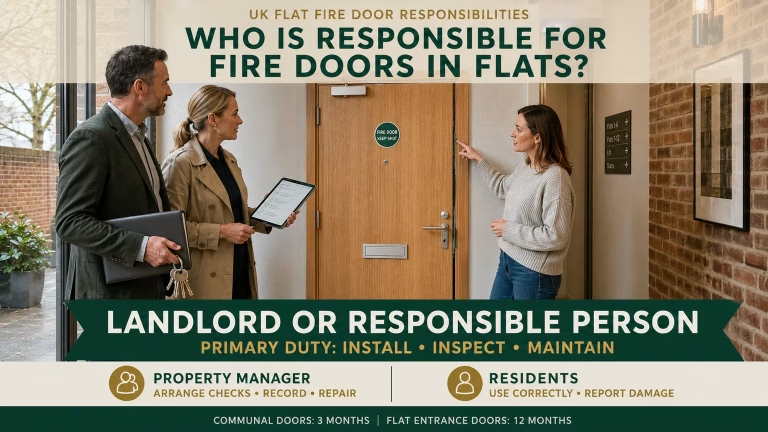
Landlords need to install, inspect, and maintain compliant fire doors under the Regulatory Reform (Fire Safety) Order 2005 and Building Regulations. Tenants need to use…
Safe Alternatives to Wedging Fire Doors
It is true that fire doors can be difficult to use, particularly in areas with heavy traffic or on hot summer days. Wedging them open, however, is not only dangerous; it frequently violates safety regulations. But what is the wise choice? Purchase authorised hold-open devices. These methods ensure automated closure in an emergency while maintaining fire doors open when needed. In this manner, you don’t have to give up on convenience or compliance. Here you can see what the alternatives are:
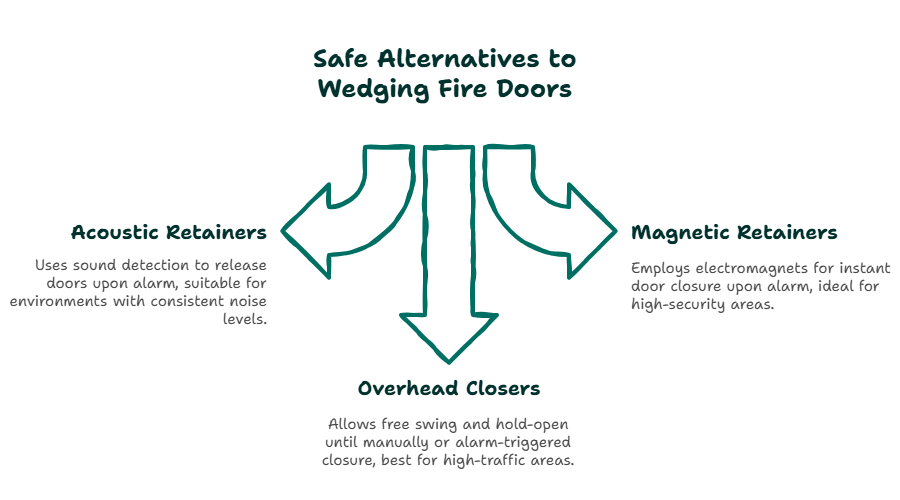
1- Acoustic Fire Door Retainers:
These gadgets use sound detection technology and fasten straight to the fire door. They keep the door open until they detect a specific noise level, like a fire alarm. When the alarm goes off, the retainer releases, enabling the door to close on its own.
2- Magnetic Fire Door Retainers:
Electromagnets that are linked to the building’s fire alarm system are used in magnetic retainers. They use magnetism to keep the door open, but as soon as the alarm goes off, the magnet’s power is cut off, and the door instantly closes.
3- Free Swing and Hold-Open Overhead Door Closers:
These combine a hold-open feature with a door closure. Until the door is physically moved or freed by an alarm, they permit it to swing freely and remain open in any position. This technique is particularly helpful in settings like schools and care facilities where doors must be swiftly closed in an emergency but are usually left open.
After all, do fire doors need to be self-closing? Yes! They do, either by default or by using approved hold-open systems. In this manner, you don’t have to give up on convenience or compliance.
Consequences of Wedging Fire Doors
Considering the serious consequences, the answer to should fire doors be left open is a clear NO:
⚠️ 1. Liability under the law: Not only is it irresponsible, but it is against the law to prop them open. You could face steep penalties, legal action, or even criminal charges.
⚠️ 2. Damage from operations: Neglecting to operate fire doors properly poses a direct risk to safety and compliance and goes beyond simple maintenance.
⚠️ 3. The Effect of the Chimney: Through open stairwells or halls, smoke and flames spread quickly upward, trapping people on higher floors and possibly obstructing vital escape routes.
⚠️ 4. Health risks: Smoke doesn’t linger; it rapidly covers an area, displacing oxygen and making breathing difficult. Smoke can enter rooms freely through jammed fire doors.
Installation, Maintenance & Compliance of Hold Open Systems
How often do fire doors need to be inspected? Compliance is required. Professionals with the necessary certifications must install these systems; no shortcuts will be allowed. In addition to being best practices, routine maintenance and inspections are required by law. Based on current official rules and industry standards, this table lists the essential criteria for installation, continuing maintenance, and compliance.
| Area | Requirement | Regulatory/Standard Source |
| Installation | Install hold-open devices (magnetic, acoustic or free-swing) on fire doors used regularly, linked to fire alarm or smoke detectors; ensure installation by competent, accredited installers. | Gov.uk & BS EN 1155 / BS 5839-1 |
| Functional Testing | Test monthly (or at least every three months) by instructed personnel; check release on alarm, manual reset and security of fixing. | CWS, GOV.UK, DoorControlsDirect |
| Annual Maintenance | Conduct yearly inspection and service by a qualified specialist per DIN 14677 / BS 7273-4; includes cleaning, checking batteries/power and verifying fire-rating integrity. | CWS (DIN 14677), Gerda Security |
| Inspection Records | Maintain logbooks detailing inspections, testing, faults, actions taken, and certificate compliance for audit and legal checks. | CWS, Gerda Security |
| Compliance Checks | Ensure regular door checks every 3–6 months (more frequently in high-traffic or residential buildings over 11 m); document self-closing and devices. | Fire Safety (England) Regulations 2022; BWF; Safelincs |
| Replacement of Detectors | Replace smoke detectors per manufacturer or standard timelines (e.g. every 5–8 years) to ensure reliable hold-open activation. | CWS / DIN 14677 |
| Legal Duty | “Responsible person” must maintain fire door systems under the Regulatory Reform (Fire Safety) Order 2005; failure may result in enforcement, fines or prosecution. | Regulatory Reform (Fire Safety) Order 2005; Fire Safety Regulations 2022 |
Impact on Insurance and Liability
Your insurance coverage may be voided if investigators discover a fire door jammed open during an event. Not to mention the possibility of serious legal repercussions, such as litigation and, in situations when carelessness is obvious, even prosecution.
- Policy risk: Since most insurers strictly enforce fire safety regulations, leaving a fire door open could jeopardise your policy. Your claim is likely to be rejected if a fire occurs and it is shown that a fire door was left open.
- Failure to comply with fire safety laws: According to UK fire safety laws, fire doors must stay closed unless an authorised hold-open device is installed. Leaving them open might get your company into significant problems.
- Legal Liability: Potential lawsuits, large penalties, and, in severe situations, jail time if someone is harmed as a result, are all on the table.
- Financial Repercussions: You will be responsible for any costs, including legal fees, damages, compensation claims, and more, if your insurance company decides not to cover you because of these mistakes.
Conclusion
So, should fire doors be wedged open? The answer is a firm no. It is essential that business owners keep their fire doors in good operating order and make sure they are always closed. Unquestionably, it is dangerous to wedge fire doors open; doing so puts lives in danger, violates fire safety laws, and may result in the cancellation of insurance coverage. Employees should get extensive training on fire door procedures and the significance of keeping these doors locked. Following these crucial safety precautions can make all the difference in an emergency.
For those needing compliant, well-fitted fire doors, here at ZDoors we provide suitable options in line with current safety standards.
FAQs
1) Can you legally wedge open a fire door for short periods?
No, that is not allowed. Propped open doors violate established fire safety regulations, which state that fire doors must always be closed unless they are held open by an authorised device that is connected to the building’s alarm system. Any other way to keep them open is not safe.
2) What are the penalties for wedging open a fire door?
According to the Regulatory Reform, those in positions of authority, like employers, who break these rules risk severe consequences, such as fines and up to two years in jail. Additionally, in extreme situations, such as when someone wedges open a fire door, they may face criminal charges for reckless endangerment or, in the event that someone is killed, homicide. In some situations, there are very serious legal repercussions.
3) Are there safe ways to keep fire doors open?
Yes, but only with approved fire door hold-open devices such as:
- Acoustic retainers (e.g., Dorgard)
- Magnetic retainers linked to alarms
- Free-swing electromagnets meeting BS EN 1155 / BS 7273-4 standards
These devices release and close the door automatically when the fire alarm sounds.
4) Why do people wedge open fire doors?
To lessen the physical strain involved in moving large objects, using wheelchairs, or carrying luggage, people frequently jam fire doors open. Others do this to increase ventilation or lower noise levels, particularly in crowded public areas or shared living spaces like dorms for students. Also, many people underestimate the dangers of keeping fire doors open because they are merely ignorant of the crucial safety function they serve in stopping the spread of fire.
5) Can wedging a fire door invalidate my insurance?
Strict adherence to fire safety requirements is typically required by insurance coverage. Insurers are likely to refuse coverage if a fire breaks out and it becomes out that a fire door was purposefully left open. As a result, building owners may be held entirely liable for any losses, lost profits, legal fees, and necessary damages.



2 responses
Thank you very much for this fantastic health and safety writeup. I work in a strictly regulated area where there are thousands of fire doors. To most people who are not involved in the business of health and safety they sometimes question why are fire doors always kept closed. Your piece throw detailed explanation addressed one of the FAQ. Vielen Dank.
Hi Benson,
Thank you for taking the time to leave such a thoughtful comment. We’re delighted to hear you found the article helpful, especially given your experience.
Thank you again for reading and for sharing your feedback. We really appreciate it.