
Fire doors are not only decorative, they’re an essential component of a building’s safety configuration. Their primary function? To prevent smoke and fire, provide adequate time for people to safely evacuate, and reduce property damage in the event of an emergency. The problem is that fire doors cannot perform their function if they are not routinely inspected. Their efficacy may be compromised over time by regular wear and tear, modifications in the building’s use, or even environmental conditions. To avoid a safety hazard that is hidden in plain sight, routine inspections assist in identifying problems. Now, let’s see how often do fire doors need to be inspected, and how to do that.
How Often Do Fire Doors Need to Be Inspected?
According to BS 9999, fire doors in the UK need to be inspected at least every six months. To understand why this is important, it helps to first know what is a fire door? It is highly advised to conduct more frequent checks in high-traffic areas such as schools, hospitals, or large residential buildings.
This practice goes beyond simply ticking boxes. Frequent inspections help identify damage, wear and tear, or overuse before these problems become liabilities. By keeping an eye on this, you not only maintain compliance but also safeguard everyone’s safety within the building.
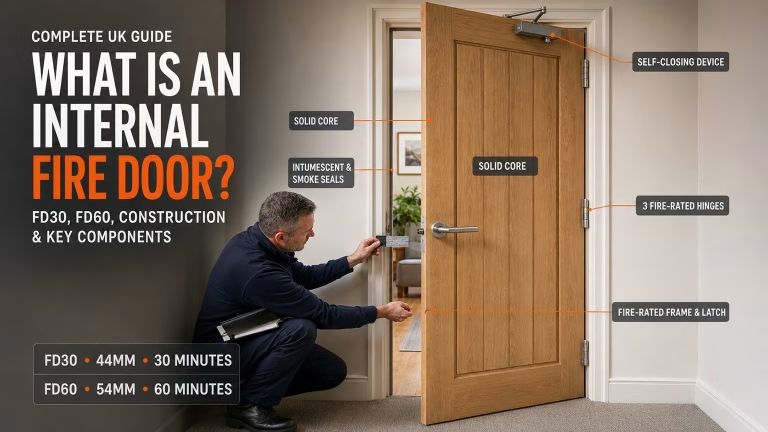
Internal fire doors are critical components of building protection systems designed to prevent the spread of fire and smoke within a structure.
Fire Door Inspection Checklist + Steps
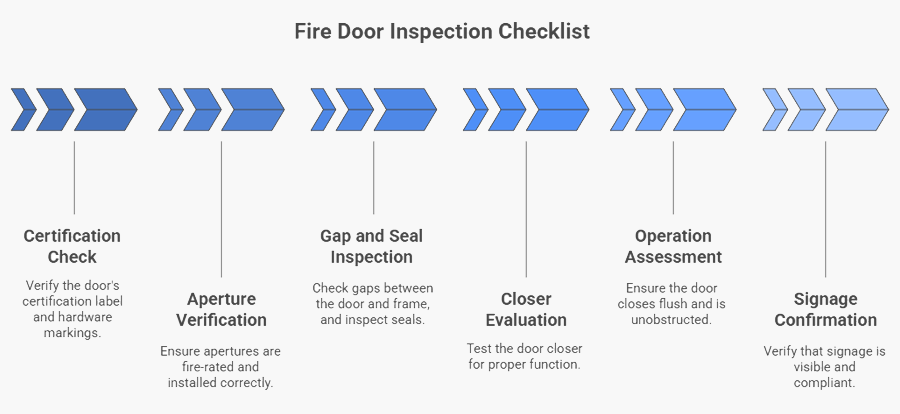
You need to follow a comprehensive checklist to ensure your internal fire doors are fully functional and compliant. During fire door inspections, you should pay close attention to the following:
1- Certification
First, it’s essential to confirm your fire door is properly certified. Look for a visible certification label, plug, or stamp, typically located at the top or side of the door. This isn’t just a formality; it’s proof that the door has been tested and meets required safety standards. Hardware matters too. Ensure every hinge, lock, or latch is CE or UKCA marked and specified to match the door’s certification.
The Forest Stewardship Council (FSC) is a non-profit that protects forests. They certify forests that meet high environmental and social standards, and products from these…
2- Apertures
Verify that apertures, such as vision panels or air transfer grilles, are fire-rated and have been installed in line with the manufacturer’s instructions. Only use intumescent glazing systems or grilles that were tested with the door as a complete assembly. Modifying a door that’s rated as solid, or using unapproved materials, can instantly void its certification.
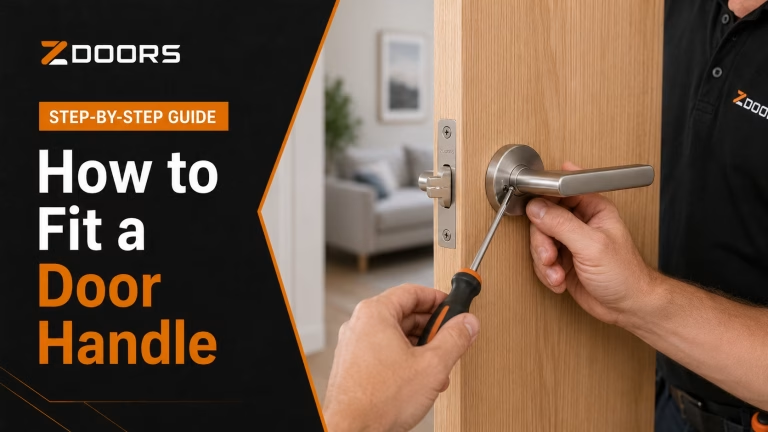
To install a door handle, mark the 1050mm height. Mark at a distance of 60 or 70 mm from the edge. A handle hole should…
3- Gaps and Seals
Start by checking the spacing between the door and the frame. It should be consistent, ideally between 3 to 4mm along the top and sides. At the bottom, you’re aiming for no more than 8–10mm, or just 3mm if you’re working with a smoke-rated door. It’s also important to confirm that intumescent strips and smoke seals (if required) are present and in good, secure condition.
4- Closers
Next, evaluate the door closer. Open the door and let it go; it should close fully and engage the latch from any open position, independently. It’s not unusual to feel some resistance because of the seals, but the door should always close and latch reliably, and manual force shouldn’t be necessary.
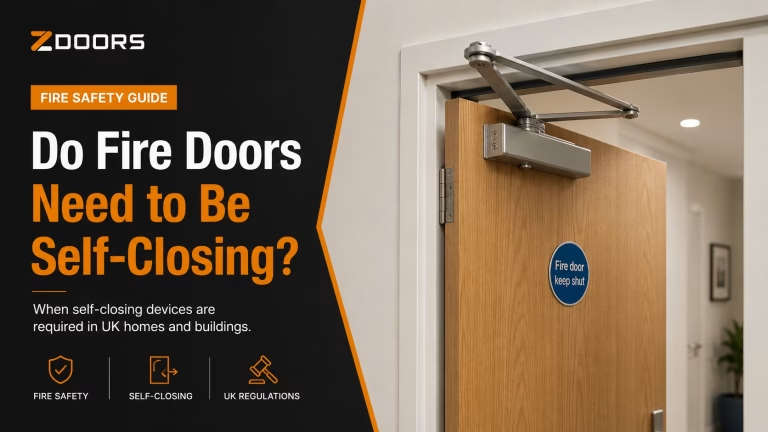
Do fire doors need to be self closing? Self-closing fire doors are crucial for building safety, automatically preventing fire and smoke spread. Legally required in…
5- Operation
Fire doors must remain unobstructed and close flush within the frame, leaving no excessive gaps. Never wedge fire doors open under any circumstances. Make sure both sides of the doorway are clear, no objects or clutter that could interfere with the door’s function or block an evacuation route. The door’s job is to contain fire and smoke; it needs an unobstructed path to do that effectively.
6- Signage
Ensure that all fire doors and fire exit signs are correctly installed and clearly visible. Signs that are missing, damaged, or obscured can cause serious confusion during an emergency and put the business at risk of breaching UK fire safety regulations.
Types of Fire Door Inspection
Types of fire door inspections include:
- Visual Inspection: A quick check for obvious damage, gaps, missing seals, or signs of tampering.
- Operational Inspection: Ensures the door opens, closes, and latches correctly without sticking or being wedged open.
- Compliance Inspection: Confirms certification labels, correct hardware (CE/UKCA marked), and that the door matches fire door regulations.
- Maintenance Inspection: Checks for wear and tear, damaged components, or parts needing repair or replacement.
- Full Fire Door Survey: A detailed, documented assessment by a certified professional, often done annually or as part of a fire risk assessment.
UK Fire Door Inspection Regulations
In the UK, fire door inspection requirements are set out in various regulations and standards. The main legal framework is the Regulatory Reform (Fire Safety) Order 2005, which places responsibility on the building owner or Responsible Person to properly maintain all fire safety measures, including fire doors. Failing to comply with these inspection requirements can lead to serious legal and safety consequences.
☑️ Residential Buildings:
For residential buildings over 11 metres tall (usually more than four storeys), Regulation 10 requires the Responsible Person to:
- Inspect all flat entrance fire doors at least once every 12 months (using every reasonable effort).
- Check fire doors in communal areas at least once every three months.
☑️ All Building Types:
For all buildings, commercial, industrial, and residential, British Standard BS 9999 recommends:
- Inspecting fire doors in common areas at least every six months.
- Inspecting fire doors in sole-occupancy spaces at least once a year.
More frequent inspections may be necessary in:
- High-traffic environments
- Buildings with specific risks
- Newly occupied buildings during their first year
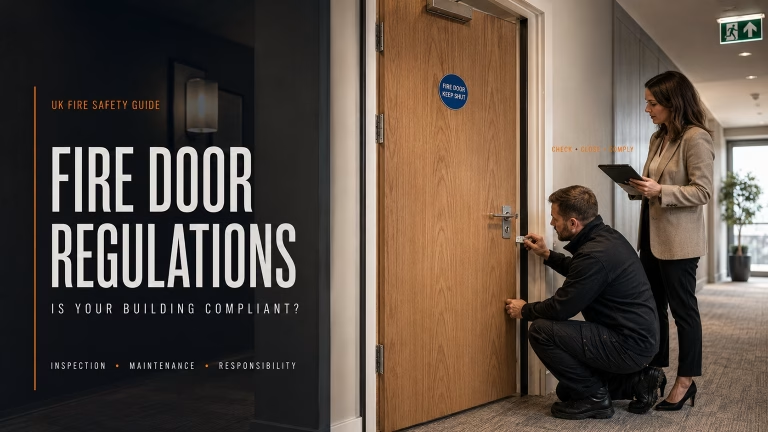
To protect all buildings from fire and enhance fire prevention, the UK fire door regulations were updated in 2025. Flat entrance doors must have at…
Key Components of a Fire Door Inspection
Here is a simple checklist to help you expedite your fire door inspections, all the important elements you should go over in one location:
| Component | What to Check |
| Certification | Label or plug visible; hardware CE/UKCA marked and correctly matched. |
| Apertures | Vision panels/grilles are fire-rated and properly installed. |
| Gaps & Seals | 3–4mm at sides/top, 8–10mm bottom (3mm for smoke doors); seals in good condition. |
| Closers | Door closes fully and latches without manual force. |
| Operation | Door closes flush; no wedges or obstructions on either side. |
| Signage | Signs present, clear, and compliant with UK standards. |
Who Can Inspect Fire Doors in the UK?
To ensure the fire doors are inspected and maintained to the required standard, the designated “Responsible Person” is legally responsible in the UK, as set out in the Regulatory Reform (Fire Safety) Order 2005. Routine visual checks (monthly or quarterly) can be delegated to a trained, knowledgeable staff member who understands how to identify a fire door components and maintenance.
However, annual inspections require a qualified professional, ideally certified through recognised schemes like the Fire Door Inspection Scheme (FDIS) or an equivalent. These professionals are equipped to identify issues, non-compliance, and necessary remedial actions.
⚠️ Important note: It’s essential to keep clear records of all inspections and certifications to prove compliance with fire authorities. Poor documentation can lead to serious legal consequences.
Consequences of Neglecting Fire Door Inspections
Failing to inspect and maintain fire doors can lead to serious consequences, including:
- Increased risk to life: Faulty fire doors may fail to confine fire and smoke, threatening building inhabitants.
- Penalties imposed by the law: Regulatory Reform (Fire Safety) Order 2005 violations may result in penalties, enforcement actions, or legal action.
- Invalidated insurance: Your building’s fire insurance policy may be nullified if the fire doors are not maintained.
- Damage to reputation: A fire safety violation can erode the public’s confidence in your company.
- Higher costs: Costlier repairs or complete door replacements may result from uninspected damage.
- Business disruption: Temporary closures or operational delays may arise from enforcement action.
What to Do When a Fire Door Fails Inspection?
If your fire door doesn’t pass inspection, you need to act fast to protect both safety and compliance. Here are the steps you need to take:
- Start by documenting the exact issues. Be specific about what failed or doesn’t meet the standard.
- If the problem is a significant safety risk, restrict access right away. Mark the door clearly so no one accidentally uses it before it’s fixed.
- Bring in a qualified professional, like a certified fire door specialist, to handle the assessment and any necessary repairs or replacements. This isn’t the time for shortcuts.
- Use only approved, certified parts (CE or UKCA marked) for any replacements, hinges, seals, closers, everything.
- After repairs, schedule a reinspection to confirm the door now meets all safety and legal requirements.
- Finally, update your records. Clearly note the repairs made, actions taken, and the date of reinspection. Keeping thorough documentation is key for both compliance and future audits.
How to Maintain Fire Doors Between Inspections
Fire doors aren’t something you can just install and forget about. How often should fire doors be inspected? Often enough to catch issues before they become dangerous. Neglected fire doors can stick, fail to latch, or just straight-up not work during an emergency, putting your people, home or business at risk. To maintain fire doors:
1. Keep Doorways Obstruction-Free: All fire doors and their exit routes must remain clear at all times. Avoid placing stock, equipment, or any clutter near these exits to ensure a swift and safe evacuation if needed.
2. Clearly Display Labels and Signage: Confirm that exit signs above or adjacent to fire doors are unobstructed and well-lit to direct people efficiently during an emergency.
3. Verify Door Functionality: Routinely open fire doors fully and release them. Doors should close and latch automatically without hesitation. If there’s any malfunction, arrange for prompt adjustment or repair.
4. Inspect Hardware and Components: All parts must be secure and in good working order. Only approved hardware should be used, and unauthorised modifications are not permitted.
5. Maintain and Lubricate Moving Parts: Clean hinges and moving mechanisms monthly to prevent dust buildup. Apply a suitable lubricant to ensure smooth, reliable operation.
6. Report and Address Issues Promptly: If you observe damage or operational problems, contact a certified fire door specialist immediately.
Conclusion
Regular use, exposure to the environment, or changes in the way a space is used can all affect how well a fire door works. So, how often do fire doors need to be inspected? Regular inspections are crucial. Misaligned hinges, worn seals, or damaged parts can all undermine a fire door’s effectiveness. Keeping up with these checks helps ensure the doors perform as intended when they’re needed most.
Protecting your property with premium, fully compliant fire doors is our first focus at Z Doors. We provide clear-cut knowledge to help you navigate fire safety regulations in addition to product delivery.
FAQs
1) How often are fire door inspections required in the UK?
BS 9999 mandates that fire doors be inspected at least every six months, with the exception of busier or higher-risk areas. The goal is to ensure that these doors truly perform their function when needed.
2) Is there a legal requirement to inspect fire doors in the UK?
Yes. If you’re designated as the “Responsible Person,” you have a clear legal duty to ensure all fire safety measures are functioning properly. It’s not optional. Regular inspections aren’t just best practice; they’re a legal requirement for staying compliant with UK fire safety regulations.
3) How often should fire doors be checked in residential buildings?
Residential buildings taller than 11 meters are subject to special fire door inspection requirements under the Fire Safety (England) Regulations 2022. Every three months, fire doors in common areas need to be examined. Additionally, each apartment’s entrance doors should be inspected once a year using the best method possible.