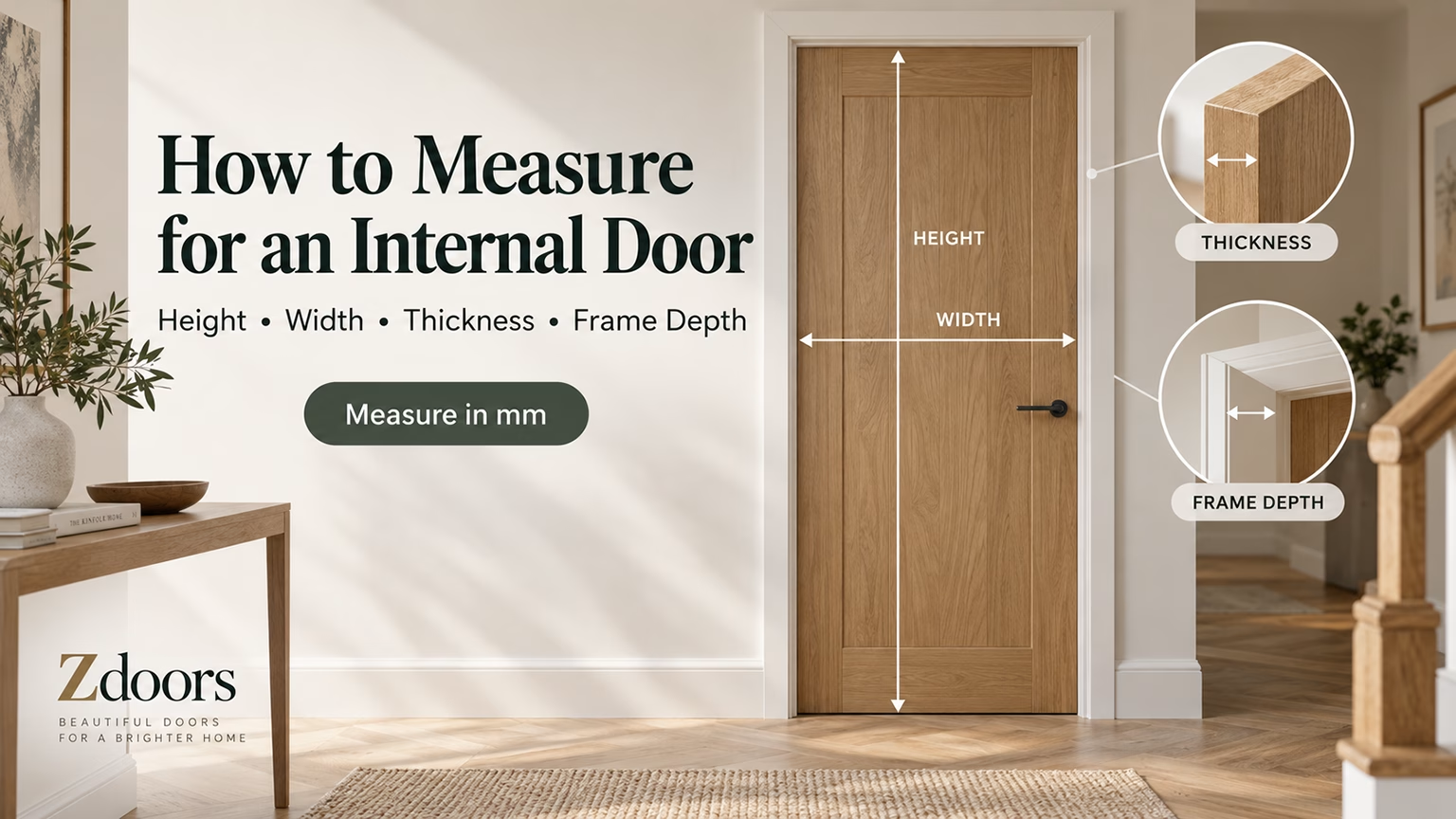
Measure the inside of the frame, not the old door. Take the width at three points (top, middle, bottom) and the height at three (left, centre, right). Order the largest figure in each case and plane the door to fit the tighter spots. Check the thickness at handle height: 35mm for an imperial door, 40mm metric, 44mm for an FD30 fire door, 54mm for FD60. Leave a 3mm gap at the top and sides and up to 9mm under the door.
Getting the right fit for an internal door might seem simple, but a few small mistakes can lead to a door that sticks, rattles, or just doesn’t fit at all. Whether you’re measuring for a replacement door or fitting one into a new frame (the lining, as joiners call it), measure carefully once and the door goes in first time. The steps below take about ten minutes with a tape measure.
Why is it important to have an accurate measurement?
A wrong-sized door rattles, sticks, or won’t fit the frame at all, and returning or replacing it costs you time and money. Careful measuring gets the size right first time and keeps any trimming within the door’s allowance, so the finished fit stays tight and the door swings properly for years.
How To Measure for Internal Doors: Easy Steps
All you need is a tape measure and a pen and paper to record your measurements. Write every figure in millimetres (mm). If your current door was trimmed to fit, tell us the frame size and we’ll find a door that trims to the same fit.
Step 1: Measure Door Height
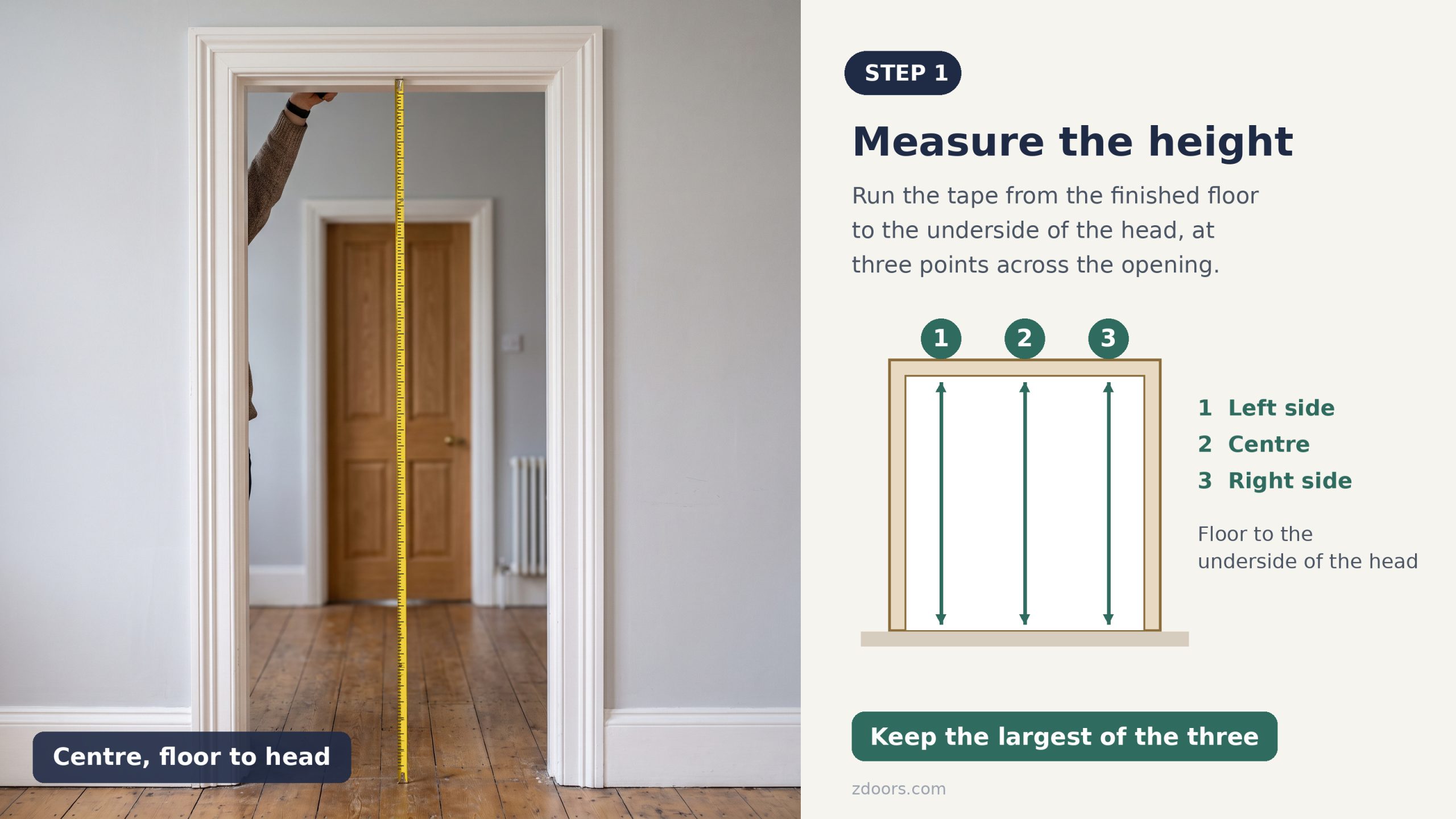
Door frames are rarely square, so measure the height at three points to see whether yours is straight.
- To begin, measure from the upper left corner to the lower left corner.
- Next, measure the right-hand side and then the centre of the frame.
- If the frame is not symmetrical, use the largest of the three, and plane the door down to fit the tighter points.
Important Tips:
Consider flooring: On the final door height, account for any existing or planned flooring including carpets or tiles that will be used. If you don’t, the door won’t close properly.
Address uneven floors: you may need to adjust the door height to account for variances in the floor surface.
Step 2: Measure Door Width
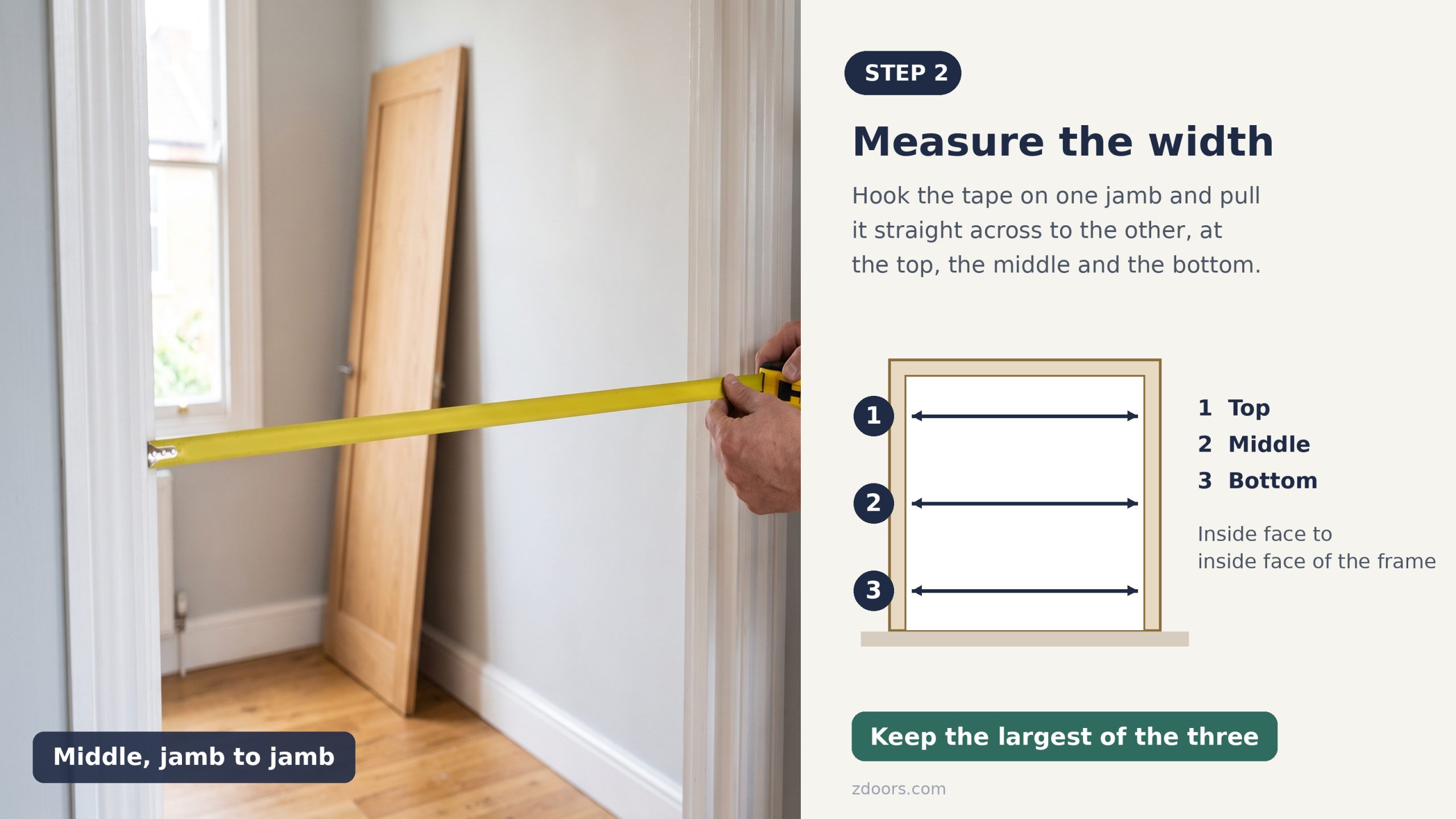
Never rely on a single measurement when measuring the width of the door because doors don’t always have a consistent width throughout. You should take three measurements from inside the door frame. To do so, first, open the door fully to access the entire frame. Then, measure the top, middle, and bottom of the door’s width. Just like the height of your door, if the frame is not symmetrical, use the largest measurement of the width for your new door, then trim it to fit the narrower points. A door cut to the smallest measurement leaves a gap at the wider points that can’t be closed. JELD-WEN’s own measuring guide puts it in one line: “Record the largest of the three measurements.”
Important Tips:
For precise measurements, ensure the tape measure is level.
Double-check your measurements to ensure accuracy.
Step 3: Measure Door Thickness
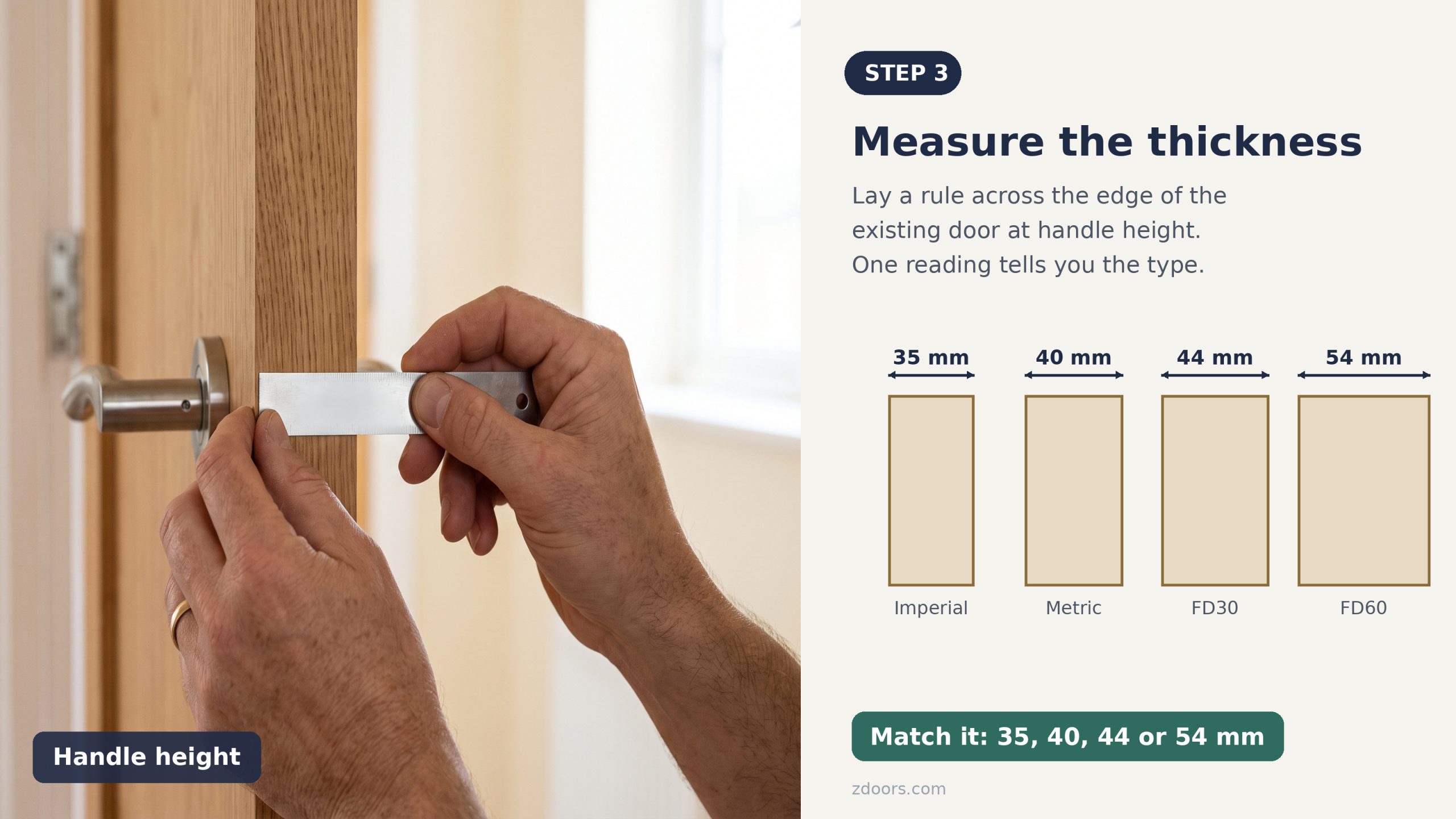
Measure the thickness of your existing door at handle height, where the reading is most reliable. Most internal doors come in one of four thicknesses: 35mm for imperial sizes, 40mm for metric sizes, 44mm for FD30 fire doors, and 54mm for FD60 fire doors. One measurement tells you which of the four you have.
| Thickness | Door type | Where you’ll meet it |
| 35mm | Imperial internal door | Most homes in England and Wales |
| 40mm | Metric internal door | Scotland and many new builds |
| 44mm | FD30 fire door (and most external doors) | Garage-to-house doors, flats, loft conversions |
| 54mm | FD60 fire door | Higher-risk locations, usually commercial |
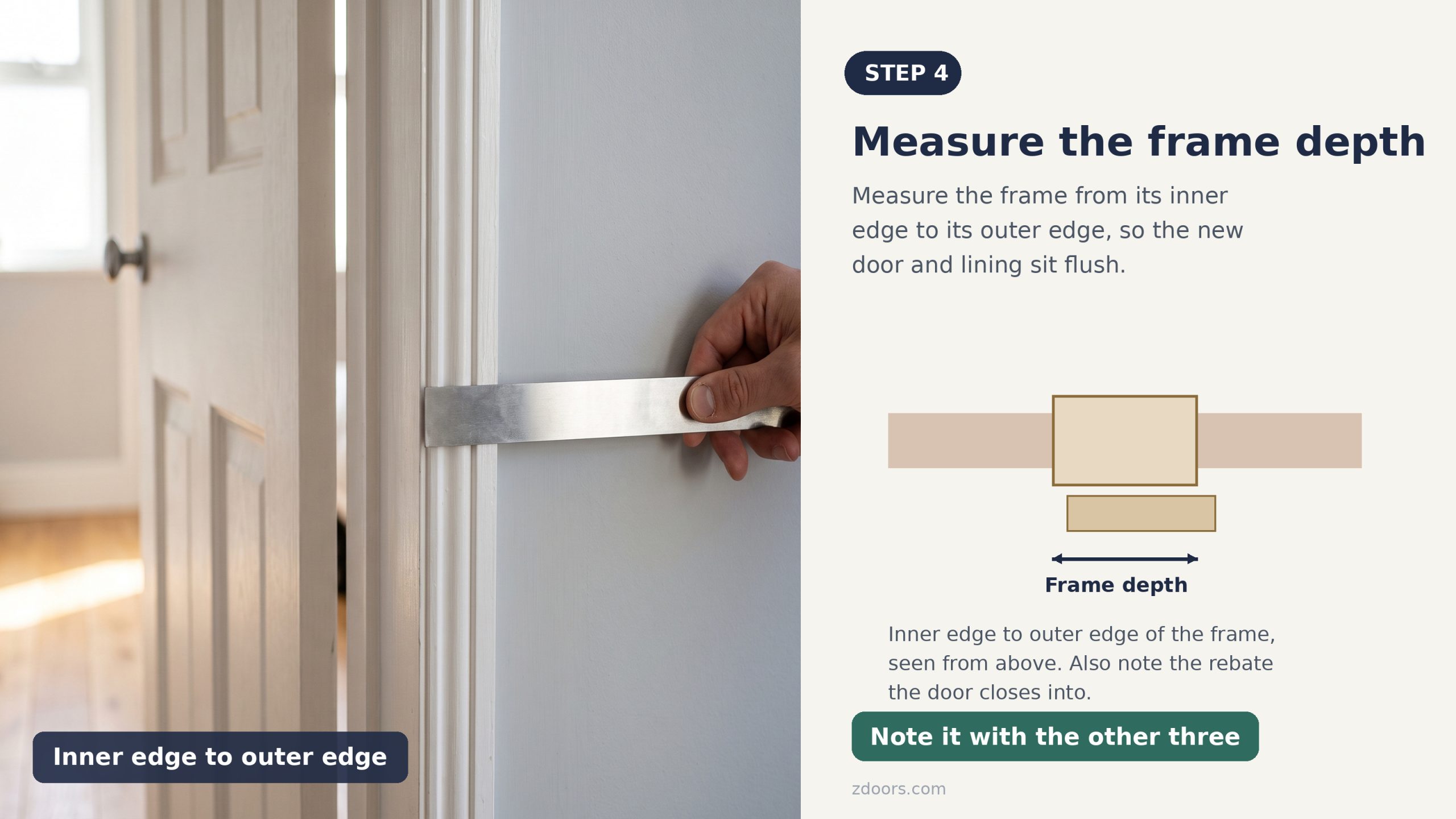
Step 4: Measure the Door Frame Depth
Measure the depth of the frame from its inner edge to the outer edge. Double-check the figure to make sure the new door and lining sit securely and swing smoothly within the frame.
The whole job, one line each:
| What | Where to measure | How many points | Which figure to keep |
| Height | Inside the frame, floor to underside of the head | 3 (left, centre, right) | The largest |
| Width | Inside the frame | 3 (top, middle, bottom) | The largest |
| Thickness | Existing door, at handle height | 1 | As measured: 35, 40, 44 or 54mm |
| Frame depth | Inner edge to outer edge of the frame | 1 | As measured |
| Fitting gap | Around the hung door | n/a | 3mm top and sides, up to 9mm at the bottom |
Internal Door Measuring Tips
A few things that catch people out:
- Always double-check your measurements to ensure a proper fit before purchasing.
- If installing new frames, adjustments may allow you to use standard door sizes, avoiding the need for bespoke doors.
- Take into account how the door opens and whether the floor is uneven, as this can impact ease of operation.
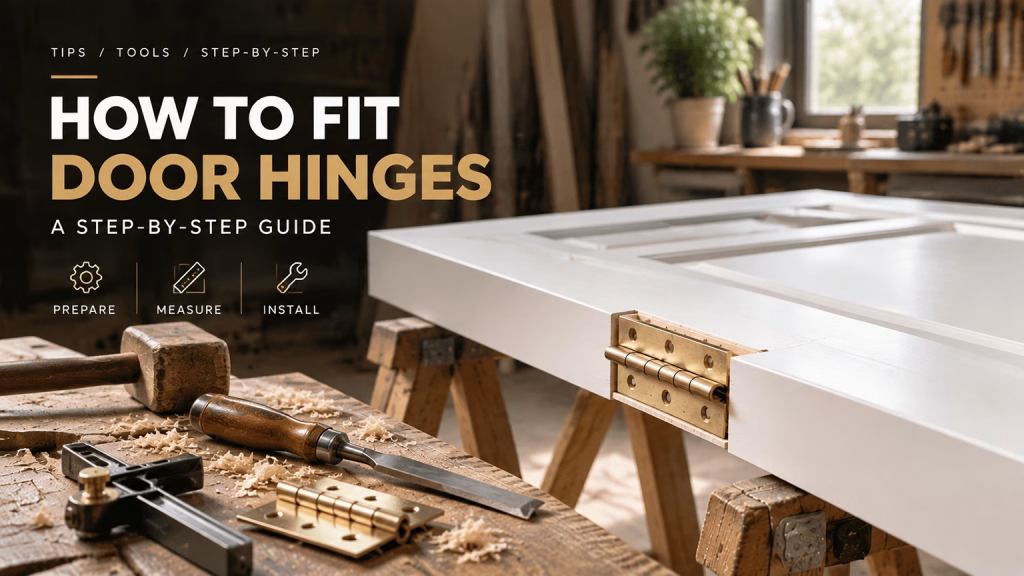
- Consider additional features, such as hinges and handles, when measuring. Our guides to fitting door hinges and fitting a door handle cover their positions.
- Be mindful of any changes to your flooring, particularly if you’re in the midst of a renovation. Factor in the depth of new flooring when measuring.
- For non-standard frames, especially in aged properties, consider choosing a standard-sized door if you’re installing a new frame.
- Most internal doors can be trimmed by 4mm to 30mm depending on the design. Check the product pages for lipping and trimming allowances; a hollow core door has less solid timber at the edge than a solid core one, which our door cores guide explains. The allowance is a limit, not a guide: trim past it and the manufacturer’s guarantee no longer applies, and on a fire door it voids the fire certificate.
- If your frame size is unusual, consider opting for a bespoke, made to measure door. We make doors to your frame size.
Measuring an Opening With No Frame
Sometimes there’s no frame to measure inside: the old lining has come out, or you’re opening up a wall. Then you’re measuring the structural opening, brick to brick or stud to stud, and the door will come with a new lining. Take the width at the top, middle and bottom and the height on the left, centre and right, as before. This is the one case where you keep the smallest figure, not the largest, because the new lining has to go inside the opening. You can pack a lining out to fill a gap, but you can’t make the wall any bigger.
To work back to a door size, allow about 51mm of the opening’s width and 63.5mm of its height for the lining and the fitting gaps, which is Door Superstore’s rule of thumb. So an opening of roughly 813 x 2045mm suits a standard 1981 x 762mm door, and one around 889mm wide suits the 838mm door. If your figures land between two sizes, choose the smaller door and a standard lining, and let the joiner make up the difference with packers. Our guide to fitting a door frame covers the lining itself, and you’ll find linings and frames in our door frames range.
Standard size for Internal doors
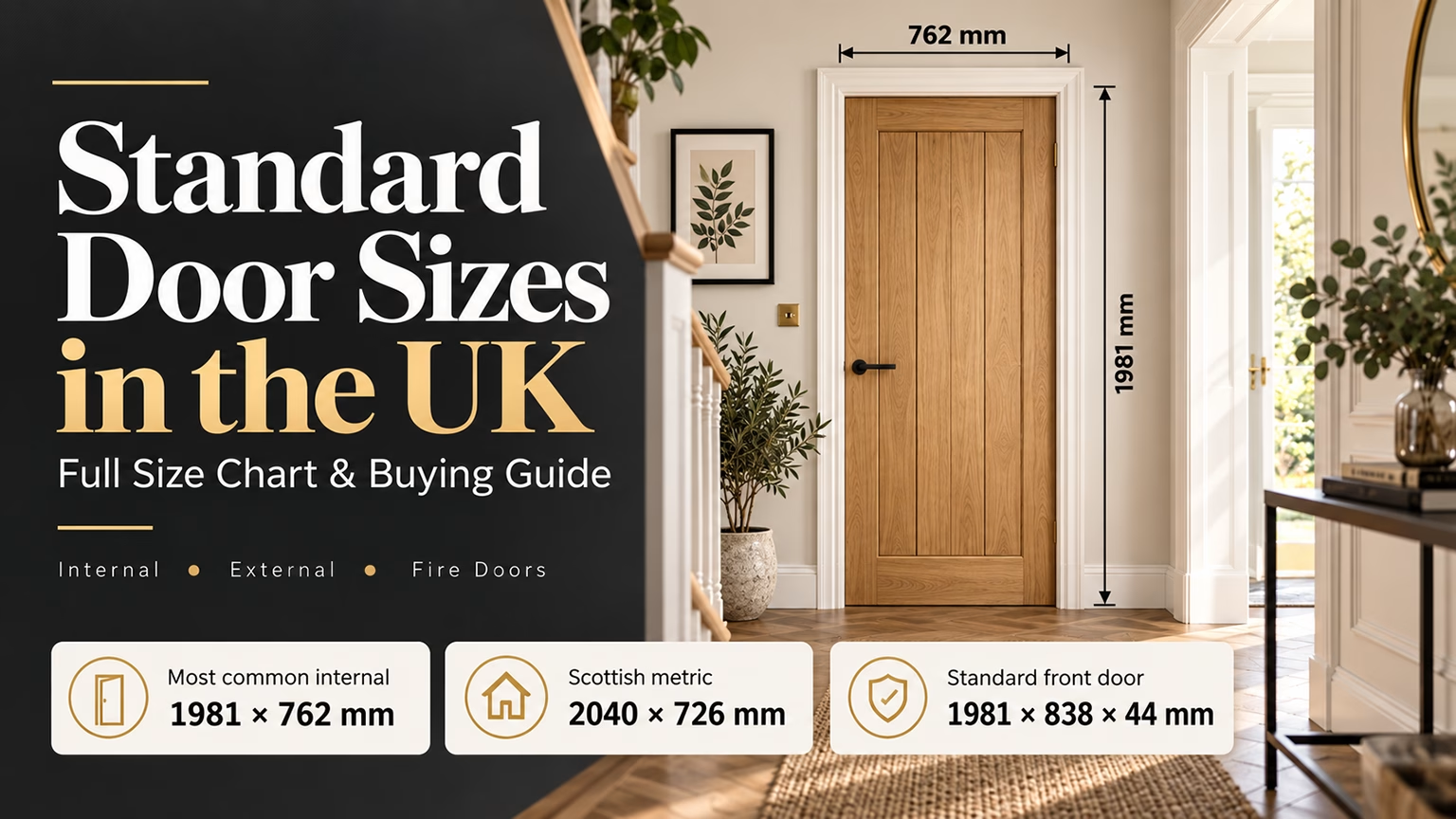
Although internal doors come in a variety of sizes, there isn’t a single conventional size. The 1981 x 762 x 35mm size is the most commonly used. Internal doors, however, usually measure between 1981 x 457 x 35 mm and 2040 x 926 x 40 mm. Conversely, internal fire doors typically measure between 1981 x 610 x 44 mm and 2040 x 926 x 44 mm. See our full UK door size chart for every stock size, in metric, imperial and feet.
What should I do if I need a fire door?
Measure a fire door the same way as any internal door, but confirm the thickness before you order: FD30 doors are 44mm, FD60 doors are 54mm, and the wrong thickness won’t sit in the fire-rated frame it needs. See our fire door sizes guide for every size and the gap rules a fire door has to meet, or browse our range of fire doors built to the same standards.
How to Measure for Bifold Doors
A bifold door splits a standard doorway into two, four or six narrow panels that fold back on a track, rather than one swinging leaf. Wickes and Door Superstore sell them in the same widths as a single internal door, 610mm to 762mm, so the opening you’re measuring is the one you already know how to measure. You’ll find the sets themselves in our internal bifold doors range.
Measure the width at the top, middle and bottom of the opening and use the widest of the three. Measure the height on the left, centre and right and use the longest of the three, the same rule as Steps 1 and 2 above.
The bifold set itself is made smaller than the opening on purpose, so the track and fittings have room to sit: around 40mm less than the opening’s height and 13mm less than its width. You don’t trim a bifold door the way you’d plane down a single leaf; the track absorbs the difference. The track sits about 19mm back from the front edge of the frame, and the bottom pivot bracket about 19mm in from the inside edge, so leave that clearance when you’re measuring around an existing architrave.
For a wider folding or sliding set, more than about 1.2m across, sizing works differently. The sliding patio section of our door size guide, linked above, covers that range.
Conclusion
Follow the steps above and you’ll get the right size first time. Remember that internal doors run a little smaller than external ones, so don’t measure across from an external door’s opening. Check the frame, the flooring, and how much you can trim before you buy. For internal, external or fire doors built to the sizes above, browse our internal doors range, or get in touch and we’ll help you choose.
FAQ
What is the standard size for internal doors in the UK?
The standard size for internal doors in the UK is typically 1981mm in height and 762mm in width. However, you should measure your doorway accurately as these measurements can vary.
Do You Measure the Door or the Frame?
Measure the frame. Your current door may not sit true within it. The old door may also have been trimmed when it was hung, so its size tells you little about the frame. JB Kind puts it plainly: “if you are buying replacement doors, DO NOT measure the existing door. You must always base your measurements on the door frame.”
What should I do if my door frame is not Straight?
If your door frame isn’t straight, you should take multiple measurements of width and height at different points. After that, use the largest measurements, then trim the door down to fit the tighter points. The door then fits even a frame that’s out of square.
How much smaller should a door be than the frame?
To ensure smooth opening and closing and good insulation for both heat and sound, you should leave a gap of about 3mm (⅛ inch) at the top and sides, and 9mm (⅜ inch) at the bottom.
How do I measure for a new door?
First, measure the door frame’s height and width at multiple points. Finally, use the largest size, then trim it down for a proper fit. Then, for measuring thickness, measure at handle height, as most internal doors are typically 35mm for imperial sizes, 40mm for metric sizes and 44mm for fire doors. Then, when measuring the frame’s depth, measure from the inner edge to the outer edge. Remember to account for flooring thickness and consider a small gap for smooth operation.
Do you measure a door in cm or mm?
Millimetres. UK door sizes are sold in mm, so a tape reading of 1981 x 762mm matches a product page straight away, while 198.1 x 76.2cm needs converting and invites a slip. Write every figure down in mm, and if your tape shows inches on the other edge, ignore that edge until you’ve finished.
Is a 30 inch door really 30 inches?
Yes. A 30 inch door is 762mm wide, and 30 x 25.4mm comes to exactly 762mm. The figure is the width of the door leaf, not the opening, so a 30 inch door wants a frame that measures about 768mm inside, to leave the 3mm gap on each side. If your frame reads 800mm or more, you’re looking at the next size up, the 33 inch (838mm) door.
Sources
- JELD-WEN, How to measure an interior door: https://www.jeld-wen.co.uk/how-to-measure-an-interior-door
- JELD-WEN, Will trimming my door have an effect on my warranty or guarantee?: https://www.jeld-wen.co.uk/advice/faq-s/interior-doors/will-trimming-my-door-over-the-recommended-sizes-effect-my-guarantee
- Deanta, Q-Mark FD30 Type 5 fire door installation instructions (trimming allowance and certification plugs): https://deantawood.co.uk/wp-content/uploads/2024/04/Q-Mark-FD30-Type-5-Rev-3.pdf
- BWF Fire Door Alliance, Understanding the fire door label (labels must never be removed): https://firedoors.bwf.org.uk/what-is-certification/understanding-the-label/
- B&Q, How to fit an internal bi-fold door (measure widest/longest; track 19mm back, pivot bracket 19mm in): https://www.diy.com/ideas-advice/how-to-fit-an-internal-bi-fold-door/PROD_npcart_100591.art
- Door Superstore, How to install a bi-fold door (40mm height / 13mm width allowance): https://www.doorsuperstore.co.uk/help-and-advice/project-guides/internal-doors/how-to-install-a-bi-fold-door/
- Wickes, internal bi-fold doors range (610mm to 762mm widths, 2 to 6 panels): https://www.wickes.co.uk/Products/Doors+Windows/Internal-Doors/Bi-Fold-Doors/c/1000658
- JB Kind, How to measure up for a new door size (measure the frame, not the existing door): https://www.jbkind.com/info-centre/how-to-door-guides/how-to-measure-up
- Door Superstore, Standard door frame sizes in the UK (opening about 51mm wider and 63.5mm taller than the leaf): https://www.doorsuperstore.co.uk/help-and-advice/product-guides/door-frames/standard-door-frame-sizes-in-the-uk/